

The Transaction
A companion piece to What You Can’t Measure (please read that first)

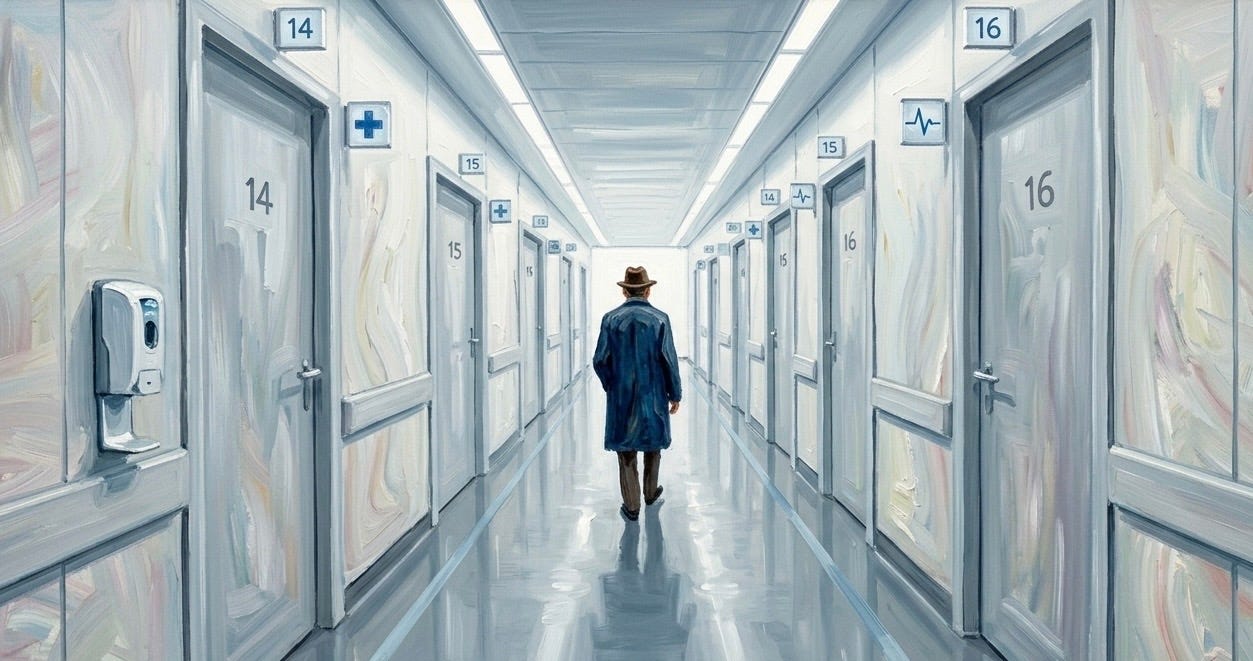
Friday afternoon. The queue says fourteen patients, average wait time eleven minutes, and I don’t know any of them.
This is the Same Day Assessment Centre. It used to be something else - I think a community hospital, maybe a minor injuries unit before that. Now it’s a pod of consulting rooms off a corridor with a waiting area and a screen that tells you where to sit. I’m here on Tuesdays and Thursdays. Supervising. That’s the word they use. What it means is I’m a GP in a building without a practice, seeing people I’ve never met, for problems that arrived this morning.
A man walks in. Fifty-something. Script query. His medication needs adjusting - something to do with his bloods, a dose that’s been flagged by the pharmacy hub. He sits down and I open his record, which is long and dense and belongs to someone I’ve never spoken to.
I do the prescription. I check the interactions. I ask if he has any concerns. He says no. I say is there anything else. He says no. The encounter is completed in six minutes. The system codes it. He leaves.
I don’t know that he has a son.
The separated cloth
His long-term condition is managed by a specialist nurse in a Chronic Disease Unit three miles away. She’s good. She knows her condition. She monitors his bloods, adjusts his infusions, follows the protocol. She sees him every four months and she knows his numbers the way a mechanic knows an engine. She does not know that he hasn’t told his children what’s wrong with him. She has never asked, because it’s not in the template.
His son is known to the schools wellbeing service. A practitioner visits once a fortnight - a kind, overworked person with a caseload of forty who sits with him in a room near the library and asks how things are going. The boy says fine. The practitioner notes that he’s engaged and making progress and recommends continued monitoring. She does not know about his father’s diagnosis. She has not met his father. She has no mechanism to meet his father.
His wife saw her own GP - not a GP, exactly, but the physician associate at the neighbourhood access hub - about exhaustion and low mood. She was offered a self-referral to talking therapies and a leaflet about carer support. The carer support service was decommissioned eighteen months ago but the leaflet is still in the rack. Nobody has updated it. She put it in her bag and didn’t call the number.
Everyone is doing their bit. Carefully. Competently.
What nobody sees
In the old model - the one I trained in, the one they dismantled - these threads would have sat in the same building. The man’s script, the son’s behaviour, the wife’s exhaustion. Different appointments, maybe months apart, but held by the same person in the same room. And over time - not immediately, not dramatically, but over the slow accumulation of encounters that weren’t really encounters at all but chapters in a longer story - the shape of it would have become visible.
You’d have noticed that the son’s referral to the schools service coincided with the father’s worst flare. You’d have seen the wife’s appointment for fatigue and thought: she’s the one holding this together, and she’s running out. You’d have known - not from a template or a protocol but from sitting opposite this man for the fourth or fifth or ninth time - that when he says he’s fine, he means something else entirely.
You’d have pulled the threads.
I don’t pull threads now. I don’t have threads. I have encounters. Discrete, documented, completed. Each one begins and ends at the edges of the screen. The man in Bay 3 is not a person I know. He’s a record I opened and a record I closed and the system shows a six-minute contact with appropriate clinical coding. The dashboard is green.
His son is still kicking walls. But that’s another service, another building, another professional who has never met me and never will.
What the dashboard shows
The numbers are good. They’re always good now. Average wait time: eleven minutes. Same day access rate: ninety-four percent. Patient satisfaction: adequate. The centre processes two hundred contacts a day across eight consulting rooms and four supervision bays. It is efficient. It is measurable. It is scalable.
What the numbers don’t show is the man who sat in Bay 3 for six minutes and left with a corrected dose and nothing else. They don’t show that his son’s anger has a source that nobody is looking for because the people who see the son don’t know the father and the people who see the father don’t know the son. They don’t show that his wife is three months from breaking because the service that was supposed to catch her was cut in a commissioning restructure that saved four hundred thousand pounds a year and was described in a board paper as a reallocation of resources to higher-impact interventions.
The numbers show a completed encounter. The encounter was appropriate. The coding was correct. The patient was seen within target.
Nobody is doing anything wrong.
The quiet bay
He left at the end. The screen went back to the queue. The chair was empty and Bay 3 was quiet and the next patient walked in eleven seconds later because that’s what the system is designed to do - fill the gap, keep moving, process the demand.
I sat there for a moment between them. Not long. You don’t get long. But enough to notice that the room felt the same as it always does, which is to say it felt like nothing. No residue. No accumulation. No sense that something had happened here that mattered, because nothing had.
Somewhere, the same family is carrying the same weight. The same silence. The same fear that nobody has named. The son is in a room near a library telling a stranger he’s fine. The wife is at home with a leaflet for a service that no longer exists. The man is driving back with the right dose and the wrong kind of help.
The threads are all still there. Every single one of them. Exposed, visible, documented across six different systems and four different organisations.
Nobody is pulling them.
The dashboard is green.
I have just read this straight after the other piece and the comparison is so true and so stark. It what we are all seeing and have been seeing for a long time and no one at the top is listening..... and when its gone...it will be gone forever
Superb writing as always, it was a pleasure to follow your thoughts as you processed what continuity of care means. At least you were able to write it like that to allow others to understand despite your knowledge being far beyond the practical, single lived experience. That is a talent shared by outstanding teachers, I hope your work reaches a wider audience including student doctors, policy makers and bean counters.