

The Thaw
Awakening

She was folding something. A towel, I think. Or maybe it was one of the kids’ school jumpers. It doesn’t matter what it was. What matters is that she was humming while she did it. Not a tune. Just a sound. The kind of absent, purposeless noise a person makes when they’re not thinking about anything in particular.
I stood in the doorway for longer than I should have. Just watching. Because that sound - that nothing sound - has been missing from this house for a long time.
The line was still there, running under her skin and out through the dressing on her upper arm. A thin plastic tube that lives inside her body now, threaded into a vein, taped down, the entry point covered with a transparent patch that yellows at the edges between changes. You get used to the sight of it. You get used to someone you love having a piece of medical equipment installed in them like plumbing. You don’t get used to the way it moves when she reaches for something. The way you can see it shift under the skin, just slightly, a reminder that the inside of her body is now accessible from the outside. That something is open that should be closed.
She was humming. And I was staring at the dressing on her arm.
The long middle
There’s a particular kind of living that happens when someone you love is in treatment. It’s not crisis. Crisis has edges. Crisis announces itself, gets responded to, passes. This is something else. This is the long middle. The bit nobody writes about because it doesn’t have a narrative arc. It just has days.
You stop planning. Not deliberately - you don’t sit down and say, right, no more plans. It just happens. You stop looking more than a week ahead because a week ahead is a blood count, a review, a scan, and everything after that depends on what the numbers say. So you shrink. Your life shrinks. Not dramatically, not in a way anyone would photograph for a documentary. It shrinks the way a jumper shrinks in a hot wash. Slowly, and then you notice it doesn’t fit anymore.
The bikes haven’t moved. They’re in the garage, tyres slowly deflating, gathering that particular kind of dust that settles on things people have stopped touching. No road trips. No weekends where the plan is to have no plan. No saying yes to things without first running the internal calculator - how tired will she be, how far is it from the hospital, what if something happens, what if something happens, what if something happens.
You survive. Both of you. That’s the word, and it’s the right one, even though it sounds dramatic for something that mostly looks like making packed lunches and answering work emails and sitting in clinic while your phone stays face-up on the desk because you’re waiting. Always waiting. Not for a call, necessarily. Just waiting. Your body in a permanent state of brace.
She survived by sitting in chairs while things dripped into her through that tube. By letting her veins be accessed like service corridors. By being cheerful about it in a way that made you want to put your fist through a wall because nobody should have to be cheerful about having poison delivered directly into their bloodstream on a schedule.
I survived by pretending the two lives were one. By seeing patients all morning and then driving to the unit and sitting in the plastic chair and watching the bag empty and driving back to finish the afternoon list. By answering “how are you?” with “fine, yeah, busy” because the real answer would take forty minutes and a diagram.
You learn each other’s limits. You learn that tiredness has a floor, and then a basement, and then a sub-basement you didn’t know existed. You learn to touch someone carefully, always carefully, because there’s a tube in her arm and a bruise you can’t see and a tiredness in her bones that has nothing to do with sleep. You learn to hold someone without leaning on them. You learn how much of love is weight-bearing, and how to bear it without letting them feel the load.
That’s the hibernation. Not sleep. Nothing so restful. More like suspended animation. Everything still running, everything still technically alive, but the thermostat turned down to survival.
The nothing sound
And then.
Something shifts. Not overnight. Not with a phone call or a scan result or a doctor saying the word you’ve been holding your breath for. It’s smaller than that. Quieter. Almost nothing.
She was folding laundry and humming.
That’s it. That’s the whole thing. She had the energy to do something pointless and enjoy it. To waste a few seconds on a sound that meant nothing. And I stood there and felt something I haven’t felt in months, maybe longer, and it took me a moment to name it.
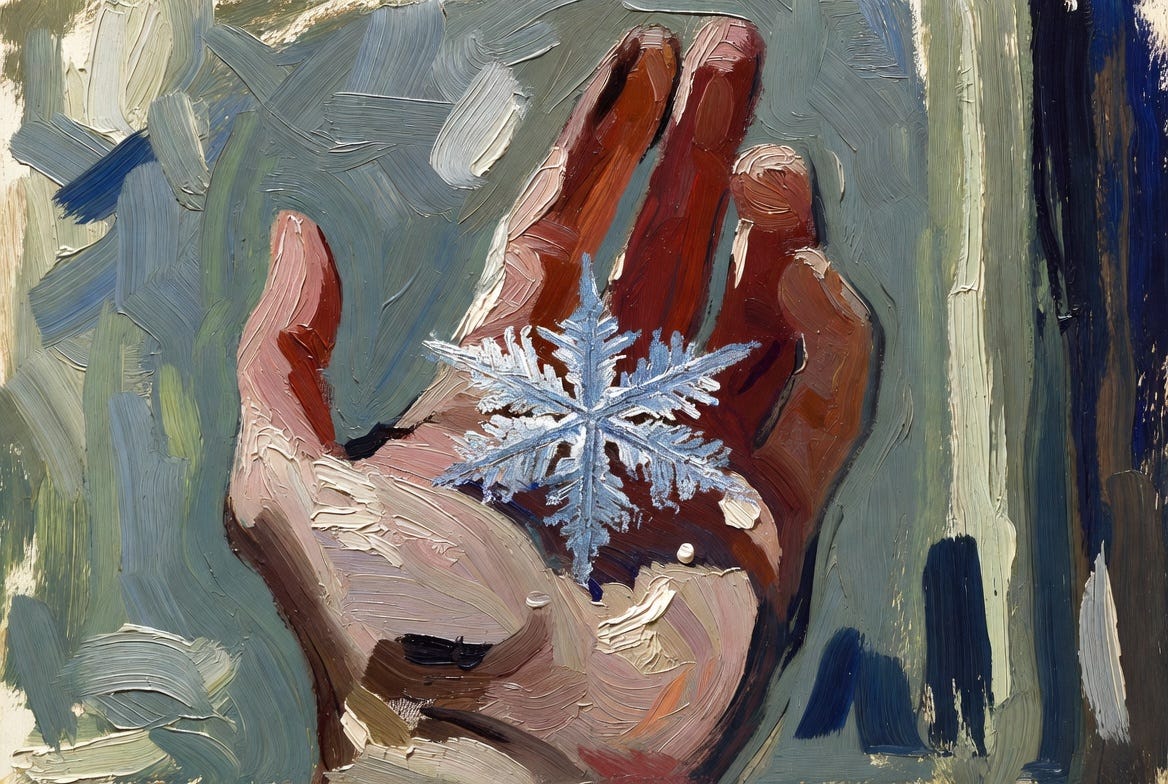
Hope. But not the bold kind. Not the kind you see on posters or in charity campaigns where everyone is smiling and backlit. The nervous kind. The kind that feels like holding a snowflake - standing very still, barely breathing, watching it sit in your palm, knowing that the warmth of your hands is already working against you.
You want to close your fist around it. Keep it. Protect it. But that’s exactly what would destroy it.
So you hold your hand open. And you try not to breathe too hard.
The subjunctive mood
We’ve started planning again. Tentatively. Hesitantly. The way you might test a bone that was broken - pressing gently, waiting for the pain, surprised when it doesn’t come, not trusting the surprise. A conversation about maybe doing something next month. Not a commitment. A maybe. A “we could.” A “wouldn’t it be nice if.” The subjunctive mood. The grammatical tense of people who’ve learned not to trust the future tense.
The tube is still in her arm. The appointments are still in the calendar. The blood counts still matter. None of this is over. The thing that is open is still open. But something has shifted from endurance to - what? Not recovery. That’s too clean a word for people who still flinch when the phone rings. Something before hope. The conditions in which hope might be possible, if you’re very careful with it, if you don’t look at it directly, if you don’t ask too much of it too soon.
New shoots. That’s what it looks like. Not a garden - just a crack in the concrete where something green has decided to try. And you stand over it thinking: please. Please don’t frost tonight.
She laughed at something on her phone the other day. A proper laugh. Not the polite one she uses when she’s tired but pretending not to be. The real one. And I felt two things at once, so fast they were almost the same feeling. Joy, and then terror. Joy, because there she is. She’s still in there. The person before all of this. And terror because - what if this is the good bit? What if this is as good as it gets and I’m standing in it right now and I don’t even know it yet?
That’s what they don’t tell you about hope when you’re a carer. It doesn’t feel like relief. It feels like exposure. Like you’ve been living inside a bunker and someone has opened the door and the light is beautiful and you’re standing there thinking: what if it’s not safe out there. What if I’ve forgotten how to live without the walls.
I catch myself doing it. The risk assessment. She suggests something for the summer and I think: that sounds wonderful. And then immediately, underneath, the reflex kicks in: what if the bloods come back wrong on Thursday. What if the scan shows something. What if, what if, what if. The machinery doesn’t stop just because the inputs have improved. Your nervous system doesn’t read the memo. It’s still checking the locks. Still listening for the sound that means something has changed.
You walk away from an explosion in slow motion. That’s what it feels like. The blast is behind you - maybe - and the world ahead looks ordinary. People are going to Tesco. People are arguing about parking. People are living in the way that used to be yours and might be again. And you’re walking toward it, but the ringing hasn’t stopped. You just can’t hear it as clearly because someone in the kitchen is humming while she folds a towel.
What thaws unevenly
I don’t know how you restart a life that never officially stopped.
Everything kept going. The school runs, the mortgage, the appointments. The surface of our life remained intact. It was the underneath that froze. The part where you make plans because you want to, not because the calendar demands it. The part where you touch someone without thinking about where the line enters the skin. The part where you laugh without it feeling like you’re getting away with something.
That’s what’s thawing. Slowly. Unevenly. The way actual thaws work - not a sudden warmth but a slow drip, patches of ground appearing through the frost, and you can’t tell yet whether it’s spring or just a mild day that will freeze again by nightfall.
I think that’s where we are. A mild day. Holding the snowflake. Trying not to grip.
She was humming in the kitchen. The tube was still under her skin. The towels were warm from the dryer.
I didn’t say anything. Some things you don’t name out loud in case the naming weighs more than they can carry.
I just stood there. Letting the nothing sound fill the house.
It sounded like a start.
How you manage to write so eloquently and tenderly through difficult times is remarkable. Sorry to read what you are all going through.
Beautiful…