

The Tally
NHS GP Partnership and the risks of the future

At 08:54 this morning, while the kettle was going and the outside dog was working out whether to trust the bowl of food I’ve put out , a screen in the corner of my study refreshed itself and put a number on the wall.
164,354.
That is what the practice has done since the first of September. Nine months. One number. It sits there with the calm of something that does not know it is frightening.
We turned on a new clinical system that day. People think a new system changes how you work. Mostly it changes what you can see. The work was always there. Now it gets counted. And once a thing is counted, you cannot pretend you did not know.
So here is what the number knows.
The bit you see
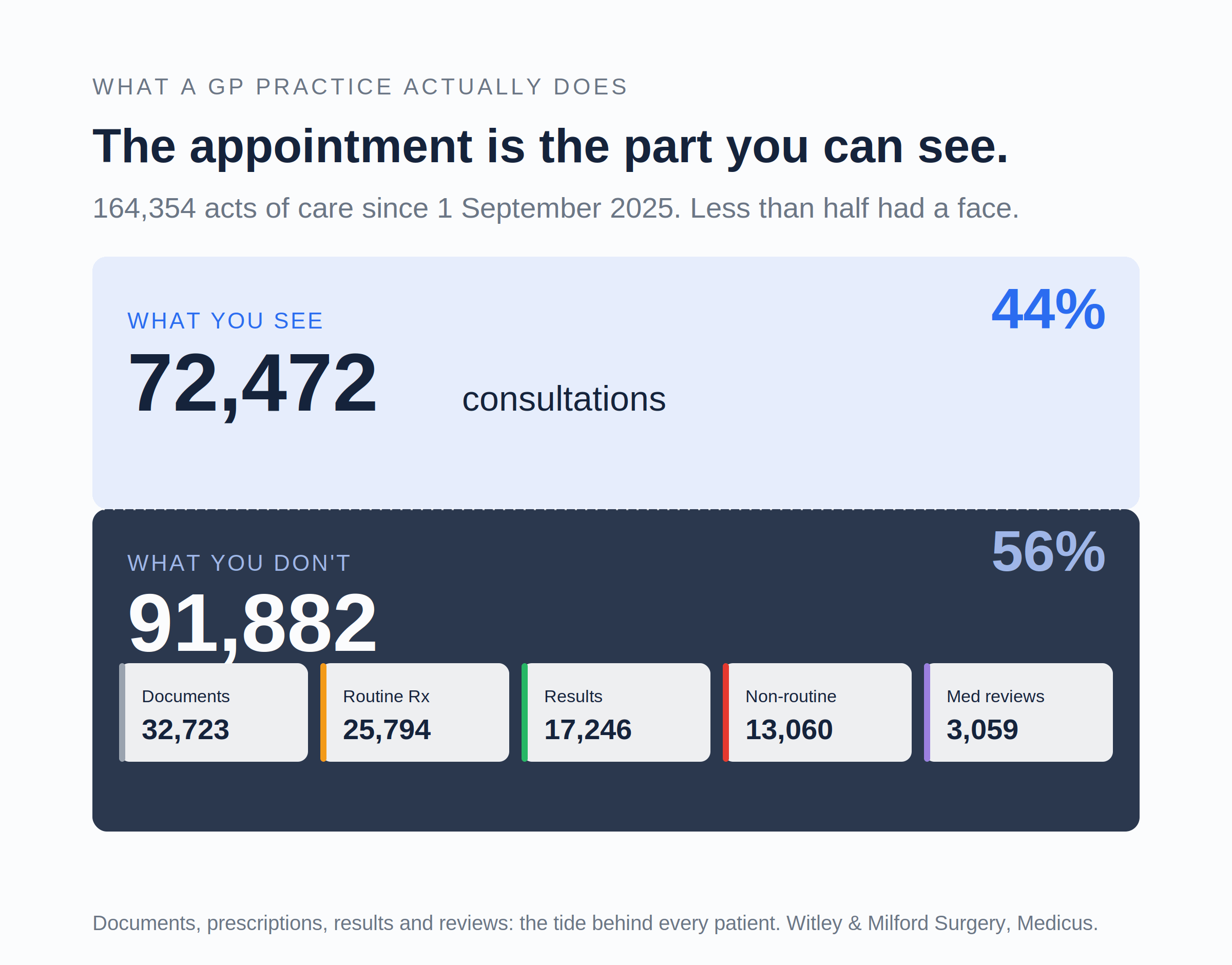
When you leave my room, you think that was the work. The ten minutes. The door, the chair, the history, the plan, the door again. That is the consultation, and there were 72,472 of them. It is the largest single thing we did. It is also less than half of everything we did.
Forty-four per cent. That is the part of general practice with a face and a voice and a name you might remember. The part that fits on a poster. The part politicians mean when they say the word appointment.
The other fifty-six per cent has no face at all.
The bit you don’t
For every patient I see, a tide comes in behind them and never quite goes out.
There were 32,723 documents. Hospital letters, clinic letters, discharge summaries, somebody else’s plan that becomes my problem the moment it lands. Each one read, coded, actioned, filed. Nearly as much work as half of all our consulting, and not one of those documents was a person sitting in front of anyone.
There were 25,794 routine prescriptions and 13,060 non-routine ones. Call it thirty-nine thousand decisions about drugs. A name, a dose, a what-if, a yes or a not-yet. Quietly, in the gaps, between the faces.
There were 17,246 results. Every blood test someone ordered, every scan, every swab, comes back to a person who has to look at it and decide whether it means nothing or everything. Seventeen thousand quiet verdicts.
And 3,059 medication reviews, the smallest pile, and the one I watch most closely, because it is what the tide reaches for first when it runs high.
Add the unseen together and it is bigger than the seen. The job is not the appointment. The appointment is the part of the tide you can see. The rest is letters.
Who carries it
Here is the part the number says out loud that we usually only mutter.
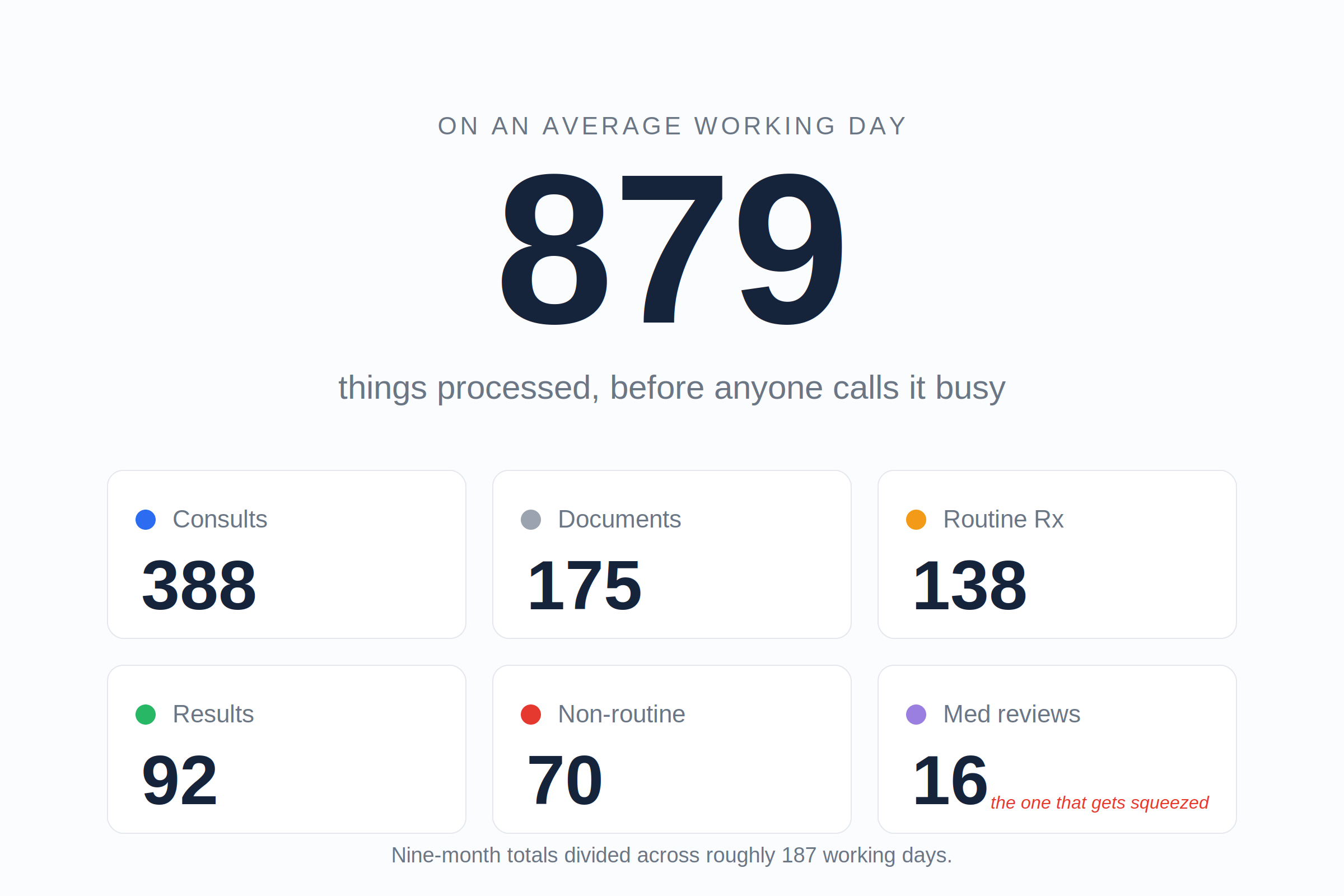
There are sixty names on this list, but the long tail of it is a mirage. Locums who passed through for a fortnight. People who left in the autumn. An account cheerfully calling itself the big boss that did fifteen things and went home. Clear those away and what is left is the thing that actually runs a practice. A core of clinicians and administrators, our salaried GPs and nurses and pharmacists and coders, most of them working hard inside the sessions they are paid for and going home when those sessions end. As they should.
And then, at the very top, three names working inside something that has no sessions and no end.
Those three are the partners. Between them they did forty-four per cent of everything. Not because they are better than the salaried GPs, who are excellent. Because of what a partnership is.
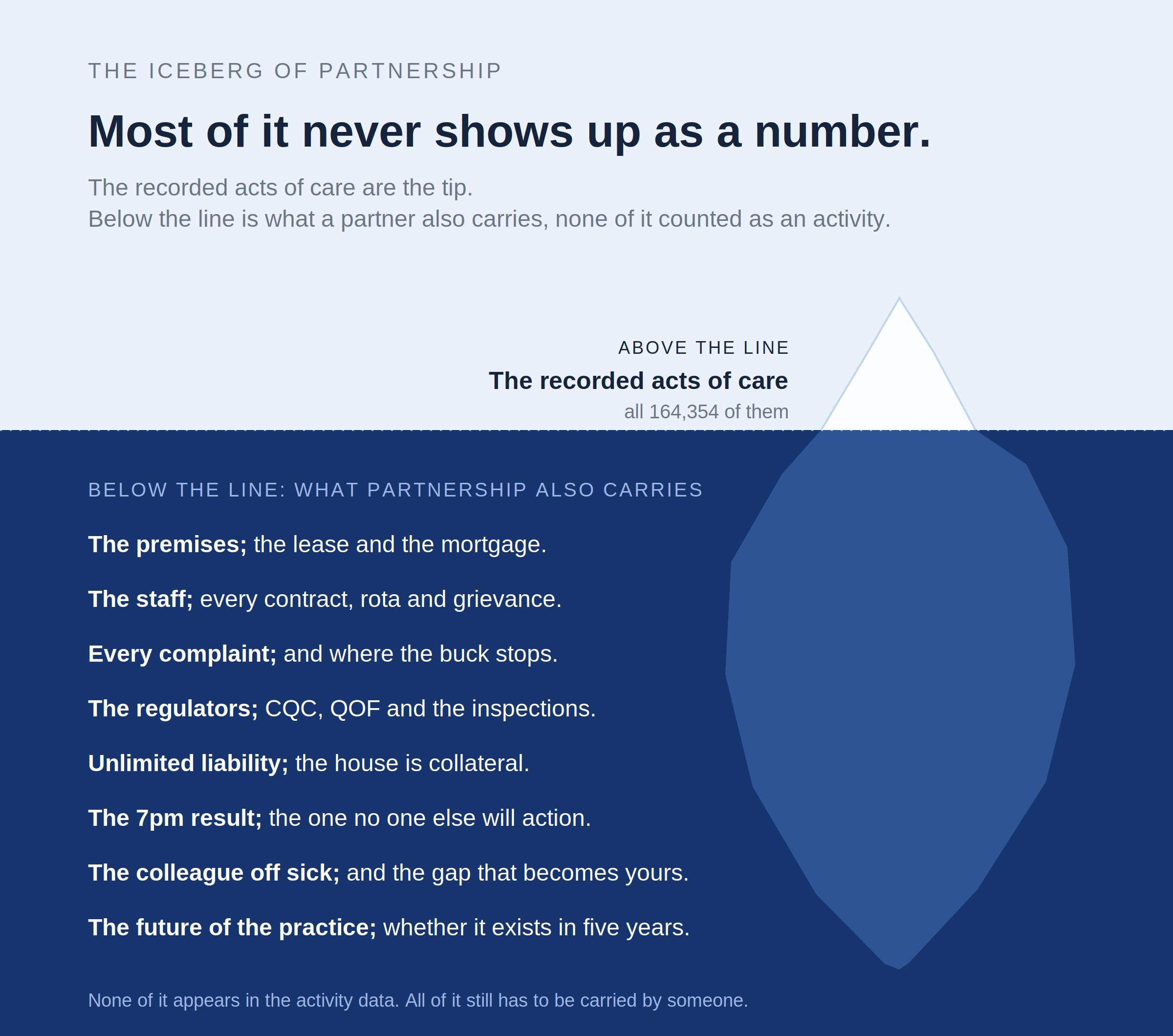
A salaried GP has a job. Defined hours, a contract, a door they are entitled to close at the end of the day. A partner does not have a job. A partner has a list. Eleven and a half thousand people who are, when everything else has been allocated, simply ours. The document nobody picked up. The result that comes in at seven in the evening. The complaint, the staff crisis, the lease, the inspection, the colleague off sick. Everything with no one else’s name on it lands, by default, on the people who agreed to carry whatever is left. Forty-four per cent is not a boast. It is a description of the contract.
I am second on the list. 24,469. I know my own number now, which is a strange thing to know about yourself.
And then there are our unseen heros.
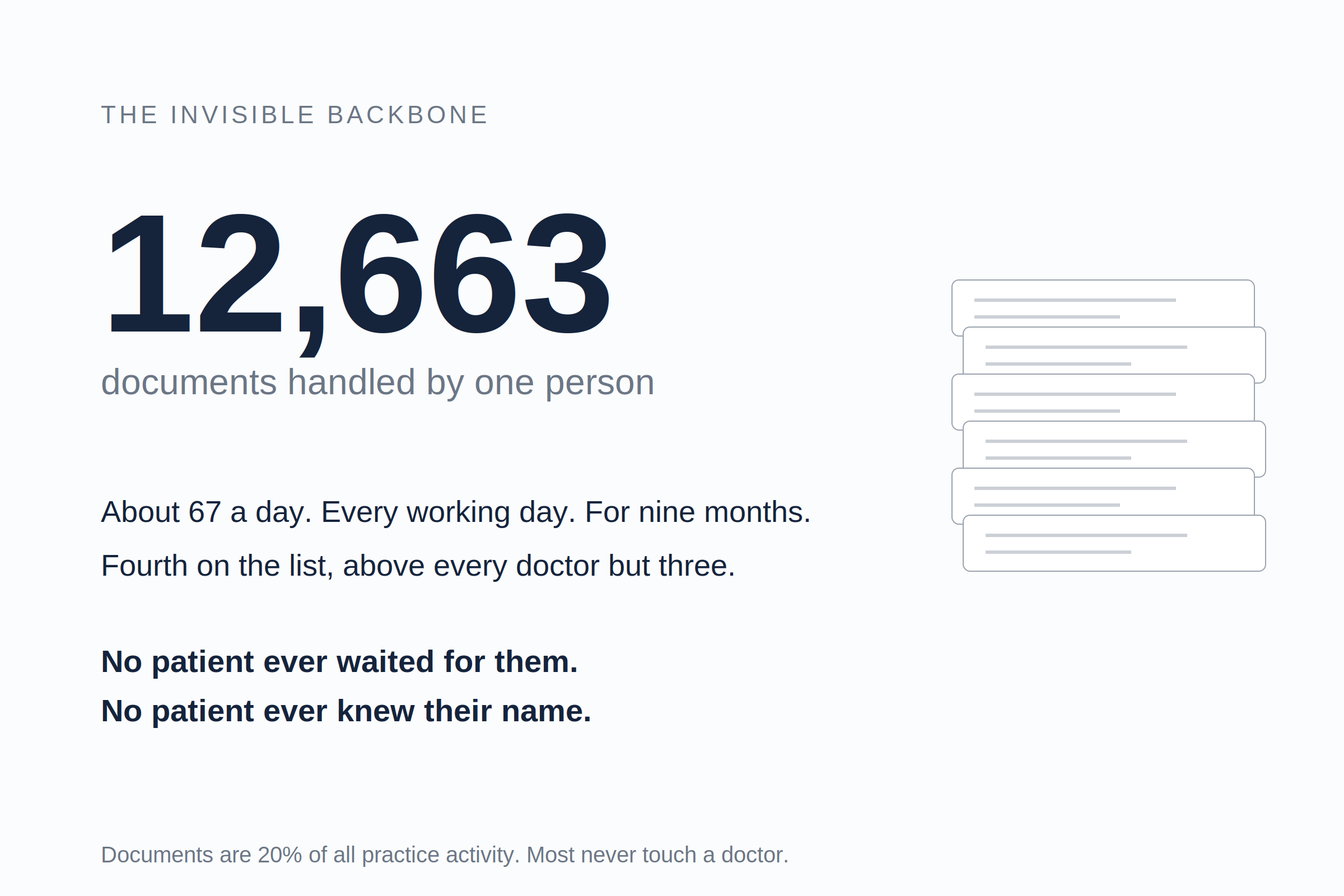
A lady who no patient will ever know about is fourth on the entire list, above every doctor but three, and almost every one of her 12,663 actions is a document. No patient has ever waited for her. No patient knows her name. She processed something like sixty-seven letters a day, every working day, for nine months, so that the tide did not come over the wall. If she stopped, you would feel it in about a week, and you would never work out why.
What the number is asking
I am not going to dress this up as a triumph or a tragedy, because it is both.
It is a triumph that eleven and a half thousand people received 164,354 acts of care from one building in nine months. Annualise it and it passes two hundred thousand a year. Nineteen separate actions for every patient on the list, every year. That is not a creaking service. That is an industrial one, running hot, and mostly running. And the reason it runs is a model where, in the end, somebody’s name is on the whole of it.
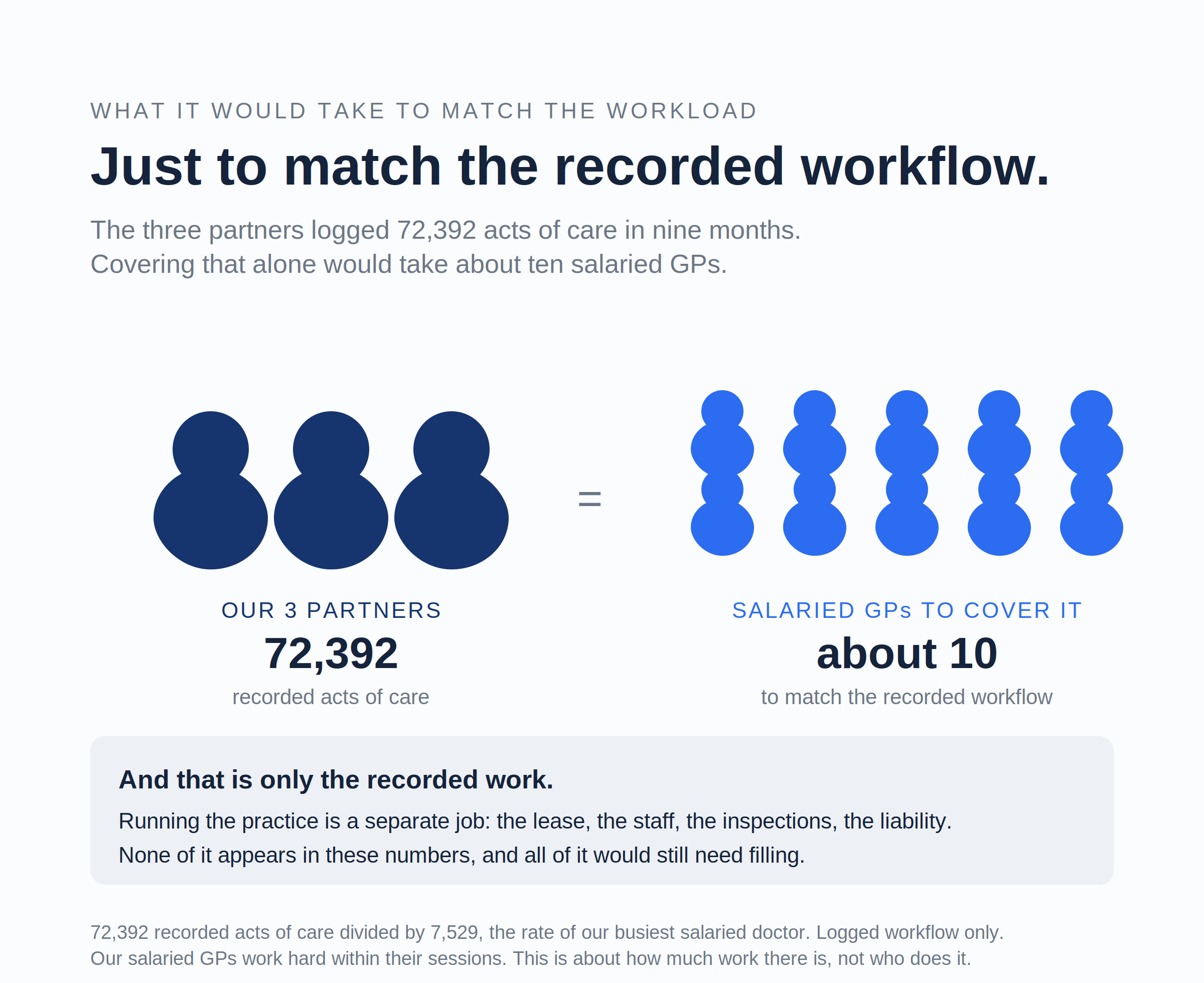
That model is going quietly out of fashion, and for reasons I understand completely. Fewer doctors want the liability. Fewer want the lease and the seven o’clock results and the buck that never finishes stopping. Salaried medicine is the sensible choice, and I would not talk anyone out of it. But notice what it leaves behind. Drift far enough towards a service of bounded sessions and locum shifts, all of it good work, and you are left with a practice in which nobody has agreed to carry the residual. And the residual does not vanish when the partners do. It simply has nowhere to land. Could we replace it with a salaried workforce as we all think is the plan?
Look again at the bottom of the pile. Three thousand medication reviews, the smallest column, the first thing a hard day quietly drops. They are nobody’s emergency and everybody’s responsibility, which is exactly the kind of work that only gets done when somebody’s job is everybody’s responsibility. Take those people away and you do not lose the drama. You lose the quiet, slow, unglamorous safe stuff that nobody was ever going to be thanked for.
The system did not make any of this. It only switched on the light.
And now I have seen the number, I cannot un-see it. None of us can. That is the cost of counting. It might also be the only honest place to start.
164,354.
The kettle has boiled. By Monday the number is larger. It is larger already.
Somewhere, a letter has just landed. And somewhere, a partner has just decided it is theirs. For now. But partnership is dying, and we fear what is to come.
Thank you as always for putting this into words. I believed so passionately in partnership but its hard to do it when a generation don't buy into it. I sadly burnout and cannot do the unseen work anymore. But I still see the stuff that lands that no one owns.... the stuff that needs to be picked up. I still pick a lot of it up but the loss of the partnership model is a tragedy
Excellent piece. And still I reckon it may be more than 10 salaried GPs you need to replace 3 partners.