

The Poker Face
Holiday, general practice and pressures.

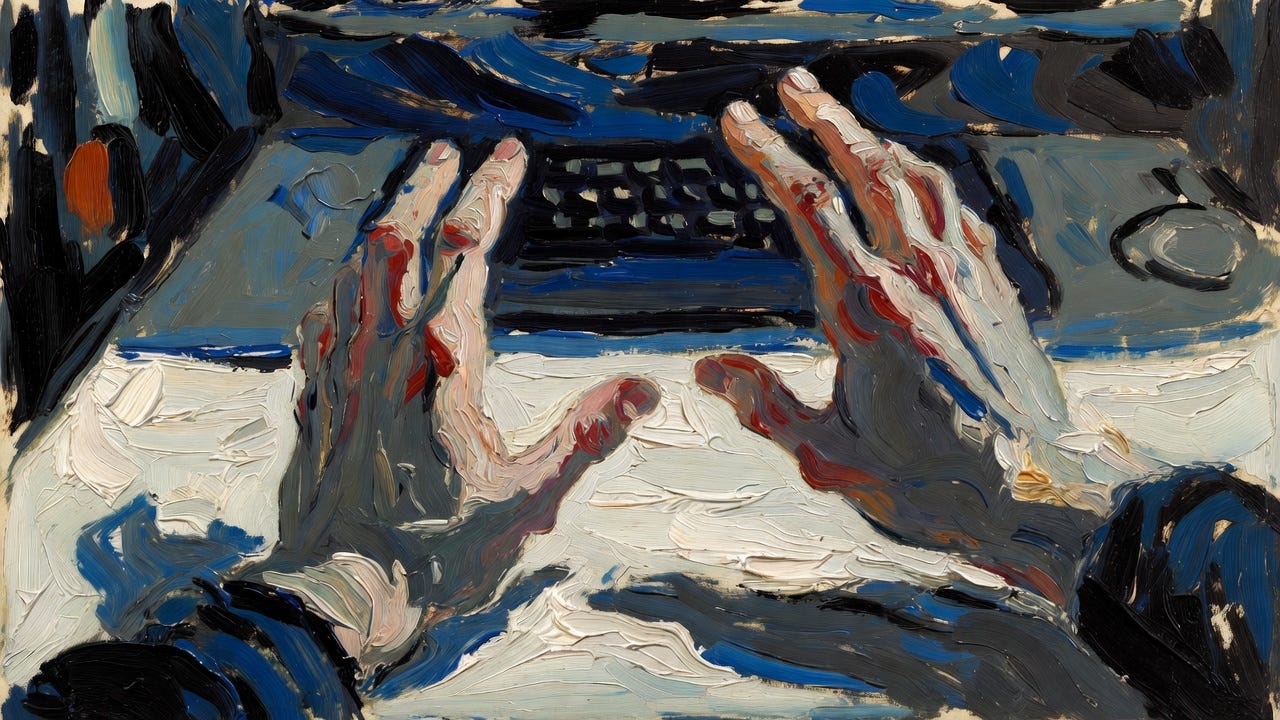
Easter week. Half term. The pattern is as reliable as weather. The schools close and the contacts rise - not because children are sicker, not because families are negligent, but because parents are home, watching, noticing, doing what parents do. The surgery absorbs it within hours. By mid-morning the queue has a texture I can feel before I’ve read a single message. Volume has its own weight.
Most of what arrives will resolve on its own. I know this the way I know most things now - not from any single detail but from the whole shape. The history, the trajectory, the way a self-limiting illness looks at eight in the morning when you’ve seen ten thousand of them.
So I redirect. Pharmacy. Self-care. A message back that is warm, clear, and honest.
I know how it reads from the other side. A door closing. A doctor who didn’t listen. A system that has forgotten what it’s like to be frightened at five in the morning.
I haven’t forgotten. I’ve swallowed it.
The cough you hold
It’s a physical sensation, the swallowing. Like suppressing a cough in a quiet room. Your body wants to do the thing - respond, comfort, pull them in. Every instinct says help this person in front of you. And you hold it down, because if you follow that instinct for every contact that doesn’t need you, someone who does need you waits. Or doesn’t get seen at all. Or gets seen too late.
The person watching you suppress the cough can’t hear it. They can’t see the reflex you’re fighting. They see a closed mouth and a flat expression and they think: he doesn’t care.
That’s the poker face. And the poker face is the care.
The ninety minutes
I am not triaging patients. I am triaging a community.
Every redirect, every “the pharmacist can help with this today,” every message that suggests self-care and monitoring - these are not clinical decisions about an individual. They are population decisions made at the scale of one person at a time, in a small room, with no acknowledgement anywhere in the system that this is what’s happening.
Ten redirects in a morning frees ninety minutes. Ninety minutes is the difference between a complex new diagnosis being managed today and being managed next week. It’s the difference between a medication review that catches a dangerous interaction and one that doesn’t happen. It’s the difference between a patient getting bad news from their own GP, who knows their name and their family and their fear, and getting it from a stranger who has never met them.
None of this appears on a dashboard. None of it features in a patient satisfaction survey. The person with new heart failure who gets seen on Monday instead of Thursday will never know it happened because a dozen other people were directed somewhere they didn’t want to go.
What gets measured is the redirect. What gets counted is the closed door. And the politicians who designed the scarcity in the first place stand at dispatch boxes and promise that GPs will do better, as though the people delivering 1.5 million consultations a day are the ones who need to improve.
We are the safety net performing the rationing that nobody voted for and nobody will name. And when the net sags under the weight, it’s the net that gets blamed. Not the weight.
What the face holds
I can’t tell you what was behind the poker face today. Not the details. Not the people. That’s part of it - the isolation of carrying the reason and not being able to share it. The parent who thinks I was dismissive will never know what I was holding at the time. They can’t. That knowledge belongs to someone else.
Nobody is coming to explain this on your behalf. Not the government, who designed the workforce gap. Not the media, who will always prefer “GP refused to see patient” over “GP protected the sickest people on their list.” The poker face holds, and the face takes the blame, and the next message is already waiting.
So you hold it. And you move on. Not because you’ve stopped caring. Because this is what caring looks like when the supply ran out and the demand didn’t.
Back to the screen.
It's the paradox of caring - it's essential to keep that detachment and distance.
I like the phrase 'Im not triaging a patient, I'm triaging a community'.
Without any doubt I can say that my GP has saved my life. Having a GP push and advocate for a diagnosis as I literally went mad, is the reason I am still here. The time he spent coordinating with other professionals, he said at one point ‘I am more like your care manager’…and yes I did feel guilt because I saw him so often. He has retired early, 57 coz he has just had enough. Thank you.