

The Opus

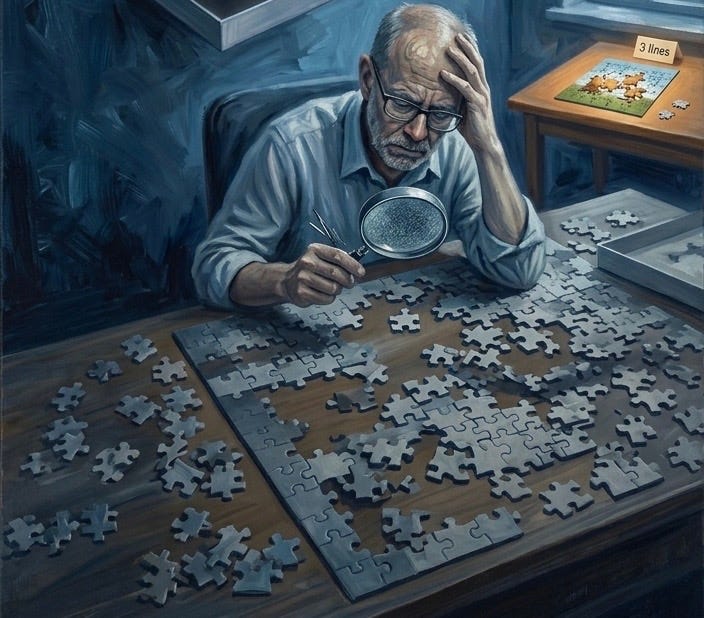
Nine fourteen on a Monday. The screen is still warm from the last triage message. Coffee half-finished, already cold. An email from a specialist pain service, opened between a medication query and a safeguarding concern.
It is enormous.
Pages of it. Eligibility criteria. Exclusion criteria. A list of things I must have tried, documented, and failed before they will consider accepting a referral. Specific medications at specific doses for specific durations. Imaging I can request but can’t interpret with any authority. Validated scoring tools I’m expected to administer, score, and act on - tools designed by the specialty, for the specialty, now delegated downward with a hyperlink and a shrug. And at the bottom, almost as an afterthought, the wait. Twelve months from acceptance. Not from referral. From acceptance.
The referral itself is a separate audition.
The picture on the box
Here is what nobody says out loud. We are being asked to finish a jigsaw puzzle without the picture on the box.
The specialist has the picture. They have the clinical acumen built over years in a single system. They have the imaging suites, the nerve conduction studies, the diagnostic injections, the multidisciplinary teams. They have the thing that makes the diagnosis possible.
And they want it done before the patient arrives.
Not approximately. Not a working impression with a differential and a question. They want certainty. They want the GP - trained to hold uncertainty across every organ system in every age group in ten-minute windows - to produce the kind of diagnostic precision that used to be what the referral was for.
You try. Of course you try. You order the bloods. You request the MRI. You wait six weeks for the scan, another three for the report. You trial the medications in sequence. You document each one, note the side effects, adjust the doses. You explain to the patient why they are trying a fourth drug when the first three only made them feel worse. You administer the scoring tool and write it up and attach it and hope - genuinely hope - that the number is high enough. Not high enough to reflect their suffering. High enough to clear the threshold.
And if it isn’t, the referral comes back. Could you try this. Could you consider that. Could you repeat the assessment in three months.
The patient doesn’t see this. The patient sees a GP who referred them and a letter that says not yet.
The gate before the gate
And now, Advice and Guidance. A&G. The next layer. The formalisation of what has been happening informally for years.
Before the referral, before the wait, before the documentation pack - now there is a conversation. A digital one, usually. The GP writes to the specialist: I have this patient, this history, this problem, I think they need to be seen. And the specialist writes back. Have you tried this. What about that. Consider this other thing first.
It is pitched as support. As collaboration. A way of getting specialist input without the patient having to wait.
But that isn’t how it works. Not really.
What it means is another gate. Another hoop. Another step between the patient and the person who might actually be able to help them. It means the GP is now defending the referral before the referral exists - justifying their clinical reasoning to a consultant who will never examine the patient, never hear their voice break when they describe what three years of unmanaged pain has done to their marriage, their sleep, their will to keep turning up.
A&G doesn’t remove the wait. It adds a preamble to it.
And here is the part that should frighten everyone: this is being rolled out as policy. Not as a safety net for uncertain cases. As a mandatory checkpoint. Every referral, every specialty, every time. The GP as gatekeeper to the gatekeeper. The opus before the audition before the queue.
You learn to write these letters a certain way. Not to communicate. To perform. To anticipate every possible objection and pre-empt it in prose. The letter isn’t a clinical summary any more. It’s a legal argument. It’s an application. It’s an opus.
The note
I know what happens when you pay. I know because I’ve done it.
My wife needed help. The kind of help that doesn’t wait well. The kind where twelve months isn’t a delay - it’s a danger. The same condition. The same clinical picture. The same specialist.
The NHS letter would have been an opus. The documentation pack, the pre-referral workup, the scoring tools, the sequential medication trials, the A&G conversation, the wait for acceptance, the wait after acceptance. Months upon months of performing the diagnosis I already knew, for an audience that needed convincing.
The private letter was a note. Three lines. Her name, her history, my clinical diagnosis. No scoring tools. No sequential medication trials. No documentation pack. No gate before the gate.
Two weeks. She was seen. She was treated. Life changed.
I sat at my desk after writing that note and felt something I still can’t quite name. Relief, obviously. Gratitude that we could afford it. But underneath that - something uglier. The knowledge that the difference between the opus and the note wasn’t clinical. It wasn’t about complexity or appropriateness or diagnostic rigour. It was about money. The medicine was identical. The access was not.
And I thought about every patient who can’t write the cheque. Who gets the opus. Who waits.
The cursor
It is still Monday. The documentation pack is still open on my screen. There is a patient who needs to be seen by someone who can do what I cannot. I know this. The specialist will know this, eventually, when they finally read what I’m about to write. But first I have to prove it. In a system that has decided the proving is my job, with tools that were never mine to use, for a clinic that might look at this referral in a year.
I could write the note. Three lines. Clear, clean, sufficient. Everything a referral needs to be.
Instead I start the opus. Because that is what Monday asks for. That is what the system has decided this patient’s pain is worth - not an answer, not a consultation, not even a place in the queue. An audition. Performed by someone who already knows the diagnosis but cannot, in this system, be trusted to say so.
The cursor blinks. I keep writing. Somewhere on the other side of this, a patient is waiting for me to finish a puzzle I was never given the picture for.
I write it anyway. That’s the job now.
This situation is so terrifying… I am filled with dread and despair… the patients will suffer so much and we will just be holding their hands :(
Thank you for your piece of writing 🙏🏽
So well put. And your analogy with private care says it all. I have so many similar examples, on both sides of the doctor’s desk.