

The Open

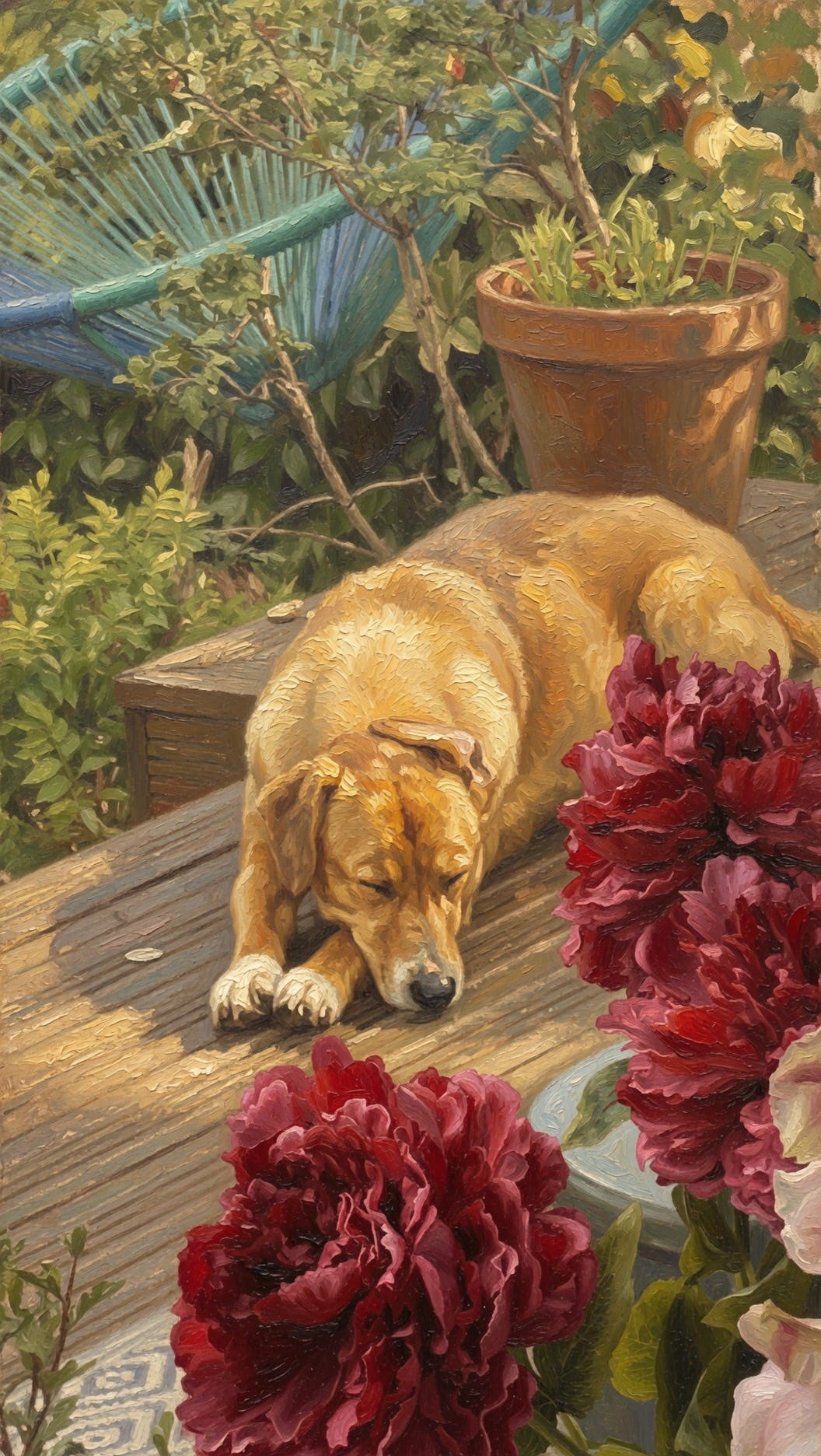
The light has gone soft and low, the kind that makes the garden look kinder than it is. There are peonies on the sill, the deep red ones, already past their best and letting petals go in ones and twos onto the paintwork. I am looking through them, and through the glass, at a dog asleep on the decking.
Her name is Rose. Months, now, she has been with us. And for most of that time the idea of her lying out there like that, flat on her side, nose almost on the wood, eyes shut, with the whole open garden at her back, would have been unthinkable.
So I stand at the window and I do not move, in case I am the thing that ends it.
Two metres
Two metres is the number. It always has been. Two metres is the distance Rose keeps between herself and any human hand, measured not in feet or in affection but in flight. Come inside the two metres and she is gone, low and fast, a ginger streak to the bottom of the garden where the brambles start. She came from Romania, from something nobody wrote down. You do not get the story with these dogs. You get the result of the story, and the result is two metres.
It has not been nothing, this stretch of months. She will come when she is called, now, if there is food in the deal. She will eat indoors, in the utility room, where for weeks she would not cross the threshold. She will play. She will steal a gardening glove and parade it round the lawn like a trophy and do her mad evening loops with her tail going like a flag in wind. She will, on a good morning, wag at the sight of me before she remembers herself and stops. There was even a fortnight where the feeding route ran clean and easy, until Olive chased her back to the den and the whole thing had to be re-drawn around the territory of a smaller, bossier animal.
She will not be touched by me. Not yet. Not once. Two metres, and not a centimetre given.
That is the ledger. That is what I would have told you Rose was, if you had asked me a week ago. A dog who has come a long way and stopped a long way short. A work in slow progress with a hard ceiling.
And then she went and slept in the open.
The wiring
I know something about standing watch. I did it for a living once, a long time ago and a long way from here, in a uniform, in places where the open ground was precisely the thing you did not lie down in. You learn that in the body and the body does not hand it back when you are done. The volume knob turns up and it stays up. You sleep, when you sleep, with one ear still running the perimeter.
That was years ago. I have a desk now. A triage list. A practice full of people who need me to be calm. And still the knob is up. Still I clock the exits in a room I have sat in a hundred times. Still some quiet part of me is scanning a tree line that has not existed for fifteen years. I am wired, in a way I did not choose and cannot fully talk myself out of, to keep that watch.
So when I stand at the glass and watch this dog put her watch down, I am not really watching a dog.
You will know this, if you carry the same wiring. You recognise your own kind. The flinch at two metres. The eating with your back to the wall. The way the body refuses to believe the house is safe long after the mind has read the paperwork and signed it off, because the body keeps its own counsel, and the body has been right before. That is the part nobody tells you. The vigilance is not a malfunction. It was correct, once. It kept something alive. It is only out of date.
What decides you
There is a school of thought, Adler and the people who came after him, arguing with Freud across the better part of a century, that says the past does not decide you. That trauma, in itself, is not a cause. That what happened to you does not reach forward through the years and hold the pen. What holds the pen is the use you make of it now. The meaning you have given it. The quiet purpose it is still serving. It is a bracing idea, almost a rude one, and people who have suffered tend to hate it on first contact, because it sounds like blame. Read more slowly and it is closer to a release. It says you are not sentenced. It says, in the end, you can put it down.
And there is a version of Rose that proves them right. Nobody made her sleep in the open. The den was still there, dark and safe and hers. She chose the boards. She gave the house a new meaning, in whatever way a creature gives anything a meaning, and the past did not hold the pen this evening. This evening she wrote something herself.
Except.
Walk towards her. Two metres, and she is gone. The past may not hold the pen but it still keeps a hand on the back of her collar. She put the watch down and she did not put it away. The body has not read the memo the soft light wrote. Adler is right about the mind, and the dog is right about the body, and they are both out there on my decking in the same animal, and they do not agree.
The gold
There is a way of mending broken pottery in Japan. You do not hide the break and you do not grind it smooth and pretend. You fill the crack with lacquer and dusted gold so the seam stands proud of the surface, brighter than the bowl around it, and the history of the breaking becomes the most beautiful and the most truthful thing about the object. Kintsugi. The repair is not a return. The bowl is not claiming it was never dropped. It is whole. It is visibly whole-after-breaking. And those are not the same as new.
That is the only honest thing I can say about the dog on the decking. She is not fixed. She is not the dog she would have been if nothing had happened to her, and that dog does not exist, and never will, and grieving for it is a waste of an evening. She is mended. The gold runs right through her, two metres wide, and you are meant to see it. The break is part of her now. So is the sleeping. Both. At the same time. On the same boards.
And so is the break part of me, and so, on a soft evening, is the rest of it. I do not get the wiring taken out. There is no procedure, no clean before-and-after, no morning I wake up restored to the man I would have been on a quieter timeline. What I get, when I am lucky and the light is low, is the occasional permission to set the watch down somewhere I could be seen doing it. To lie in the open. To put my nose to the wood and trust the garden not to come for me.
Even writing that, I can feel the knob turn up. She could bolt. The peonies are dropping. Something could shift by morning and the whole careful architecture could come down, two metres widening back to the bottom of the garden, the den again, the long slow start again. The calculator does not switch off because the inputs improved. It never has. It just lets me look away from it for a minute, and a minute is the most anyone gets, and I have learned to take the minute.
I said her watch was over. That was the light talking.
Her watch is not over. Mine isn’t either. We have just agreed, the two of us, on a Tuesday with the peonies going over on the sill, to put it down for a while.
Out on the decking she has not moved. Through the glass, through the flowers that are nearly done, I watch the broken thing sleep in the open. The gold shows from here.
I let it.
Writing lyrically and truthfully about trauma and the hypervigilance it causes is an amazing skill. I love reading these posts