

The Mileage

I’m going into a storage compound on the edge of town, behind a steel gate heavy enough to need both hands. Rows of caravans and motorhomes parked nose to tail on open tarmac, every one of them somebody’s, every one of them standing still, the heat coming off the ground in waves you can see.
Our van is in the third row. It has been there a long time.
I came on my own.
There was a job to do and it was a grim one. Photograph the van. Empty the last things out of it. Hand what was left over to a stranger. Nobody had asked me whether I wanted to do it. That is not how a job like this arrives. It arrives as a thing that simply has to be done, by someone, and the someone turns out to be you, on a bank holiday, in the heat, on your own.
It had stood so long it would not wake up. The battery had given out somewhere in the long months of not being asked for anything, and so before I could even photograph the mileage I had to bring the thing back to life. Jump leads out of the boot of the car. A few seconds of nothing. Then the cough, and then the catch, an engine remembering itself. The dashboard came up all at once, lit and eager, as though no time at all had passed.
Twenty-eight thousand miles.
I held my phone up and took the picture, and then I sat down in the open doorway in the heat, because what I was doing was not really maintenance. It was a funeral. A small one. Private. One mourner, no flowers, and a body that had started first time the moment I asked it to.
A private funeral
You can empty a van in an afternoon. That is the trap of it.
You cannot empty a marriage in an afternoon. You cannot empty a diagnosis. The future we had assumed, the one with all the long trips still folded up inside it, has no door you can open and no shelves you can clear. The losses that actually matter do not have edges, or handles. They will not hold still long enough to be dealt with. But a van will hold still. A van has a door, and a key, and a finite number of cupboards. And so the van becomes the place the whole of it is quietly allowed to come and land. It is not the loss itself. The loss itself has no shape at all. The van is only the part of it small enough to be lifted, and bagged, and driven away.
So when I tell you that I spent the afternoon clearing out a van, understand that I am not really telling you about a van.
You do not realise, until you have to empty one, that a motorhome is a house.
Not like a house. A house. It has a kitchen the size of a hymn book. It has a bed you build every night and take apart every morning. It has drawers whose contents every member of the family could recite with their eyes shut. It has a smell, and the smell is yours, and after the first year you stop being able to smell it at all, because your own life is not a thing you can smell.
I opened it up and the heat and the smell of it came out to meet me, and I started to take the life out of it.
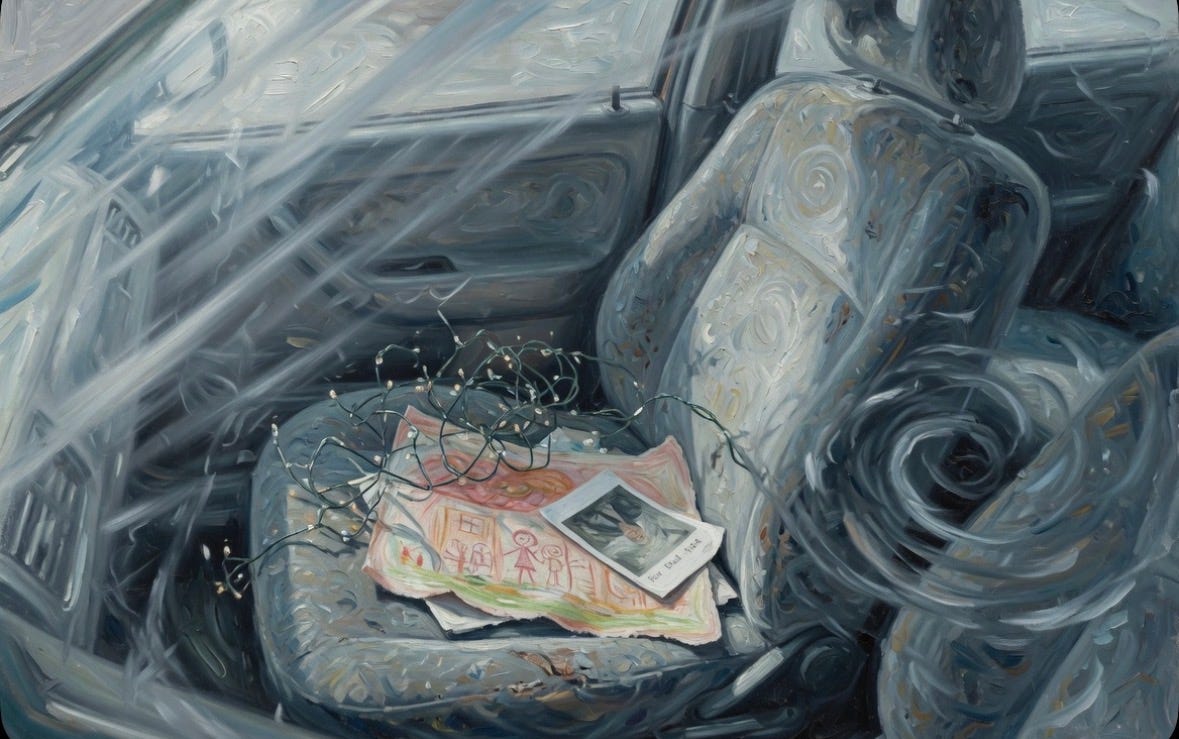
There were lights strung along the inside, the small sparkling kind, the kind somebody puts up to make a metal box feel like a place you would want to be. I took them down. There was a photograph of the five of us. I took that down too. And there was a photograph of a friend of ours who has been dead for years, pinned up all this time in a van she is not here to miss, and I stood and held it for a while, because until that exact moment I had not understood that the van had been quietly carrying our dead around with it already.
The children left a drawing, gone soft and furred at the edges, of what I am fairly sure is the van itself, all five of us standing beside it and every one of us drawn the same height. And the small flat pocket games you buy specially for travelling, the ones that fold down to nothing, because a family on the move learns to love anything that folds down to nothing.
She made that van. Strung the lights, chose the soft things, turned a cold shell on a forecourt into somewhere you wanted to be. And then she drove it. In every way a thing can belong to a person, it was hers.
Then I climbed into the back and sat down.
The back of that van is where my parents would fold themselves in with us and we would play cards in the yellow inside light until it got too dark to read them. It is where we ate, elbow against elbow, meals that tasted better for the smallness of the space. And it is where we slept in the first days of being married.
I sat this afternoon in that exact spot, on my own, deciding which of our things were worth keeping and which were going in a bag for the charity shop. You should not have to do both of those things in the same six metres of your life. But nobody is handing out shoulds. That is just what the job turned out to be.
Sitting there, the van starts giving it back to you whether you have asked it to or not. The hollow drum of hard rain on a roof eighteen inches above your face, and how it is, against all sense, the safest sound there is. The squeak of a sleeve dragged across a fogged window to let a cold morning in. The way five people learn to move around one another in a space the size of a downstairs toilet without once colliding, a private choreography drilled in over years and worth precisely nothing anywhere else on earth.
A van you are about to sell does not hand you back the bad days. It only hands you the good ones. That is the particular cruelty of it. You sit in the middle of something that is ending, and it insists, the whole time, on showing you how good it was.
And so I cried. Not kneeling, not loudly. I sat where the bed used to be made up and I cried the way you cry when you have run out of other things to do with your face.
I have been trying, since, to be honest about what the crying actually was.
Some of it was the plain thing. You cannot sit in the place where a marriage physically started and fold it into bin bags without something in the chest giving way.
But there was something underneath that, and it took me the whole afternoon to get down to it. For as long as the van sat in that compound, paid for, dusty, untouched, the life it belonged to had not really ended. It was only paused. There was still a version of things where the bad stretch passed and we went and fetched it and pointed it at the sea. The van was the proof that that version was still possible. And what I had driven out to do, alone, with a roll of bin bags, was take that proof apart with my own hands. Not pause it. End it. And it had to be me, because it could not be her, that seems cruel and unjust and I don’t know why I feel that. I was not clearing a van. I was carrying out a sentence we’d had placed upon us, and I can’t stand that it has and would carry it all, and all the pain if I could. But we all know that isn’t possible. You can just try.
There is nothing wrong with it either, and it feels a part of us that is being discarded for nothing. That isn’t true but it is what that feeling in my chest says. It’s almost the hardest part. It started first time. The fridge still gets cold. The van has not failed anybody. It is, if I am honest, in better health than its owners. You end up getting rid of the sound thing because the precious thing has broken and cannot be mended, and the sound thing has the bad luck of being the one you can still get your hands on.
Twenty-eight thousand miles. I keep going back to it. For a motorhome ten years old, twenty-eight thousand miles is almost nothing. It is a van that has spent the overwhelming part of its life standing completely still. We bought a thing built to carry a family across whole countries for decades, and we used a corner of it, and the whole time we told ourselves there was no hurry, that the long trips were still to come, that this was the beginning of something and not the most of it we would ever get. The number on that dashboard is not a record of where we went. It is a record of everything we were saving for later. And later, it turns out, is not a place that everybody is allowed to reach.
The last of it, the part I could only get to once the rest had been said, is that none of this was a choice. There is a tidy word people reach for here, and the word is acceptance, and they offer it as though it were a calm room you finally walk into and sit down in. It is not a calm room. Acceptance does not feel like peace arriving. It feels like the pain being let all the way in at last, because you have stopped holding the door shut against it. I did not sell the van because I had made my peace. I sold it because, in the end, nothing else that could be done. That is what acceptance turned out to be. Grief, with the arguing finished, and nothing left to hold it off. No cosy moments of Hollywood deliverance and growth here.
A different shape
There is a smaller van coming. I should say that plainly, because said quickly it sounds like good news.
Smaller. Manageable. That is the word that gets used. Manageable. It is a kind word and a cruel one at the same time, because you only reach for it once you have admitted that the other thing, the bigger thing, the thing the way it was, has become unmanageable. Nobody calls a life manageable while it is still simply their life.
So there will be another van, and we may, the sentence goes, do all of this again, in a different shape.
I cannot make myself believe the sentence. I turn it over and over and I cannot get it to take any weight. Not because the words are a lie. Because even if every one of them comes true, even if we are out there next summer with a kettle and a folded map, those days, the ones I was sitting inside this afternoon, are not coming with us. They were never made out of the van. They were made out of a particular stretch of years, and a body that could still be relied upon, and the enormous, unrepeatable luck of not knowing that we were lucky.
I wrote here, not long ago, about my old self dying. It felt, while I was writing it, like the heaviest thing I had ever put down. But it is mine to hold and manage, and my burden alone and that feels almost acceptable.
This was heavier. Because the death I imagined has not really happened, and this one had. And I am starting to understand that this is the actual work of a long illness, the work it does quietly in the gaps between the appointments and the blood tests and the days that look, from the outside, like nothing has happened at all. It does not wait for the big death. It holds the small ones.
It buries things in instalments.
A van. A pair of walking boots that stop getting laced. A flight nobody books. A hill that quietly comes off the list. A plan you stop saying out loud, and then stop making at all. And you go to every one of these funerals on your own, and you are always the only person alive who knows there has been a death.
Someone will buy the van. They will get a sound motorhome with twenty-eight thousand honest miles on it. They will not get the back of it.
I closed the steel gate behind me, both hands, the way it needs. And I drove home with the lights and the drawing and the pocket games on the passenger seat, and the photograph of the five of us lying face down on top of them.
Beautiful, heart-breaking and so moving. You are such a skilled writer, finding ways to express the inexpressible. That sounds trite, given what you're going through, but I'm sure your writing helps others and I hope it helps you a little too.
I was quite emotional reading this Dave. It's beautiful.