
The Mask

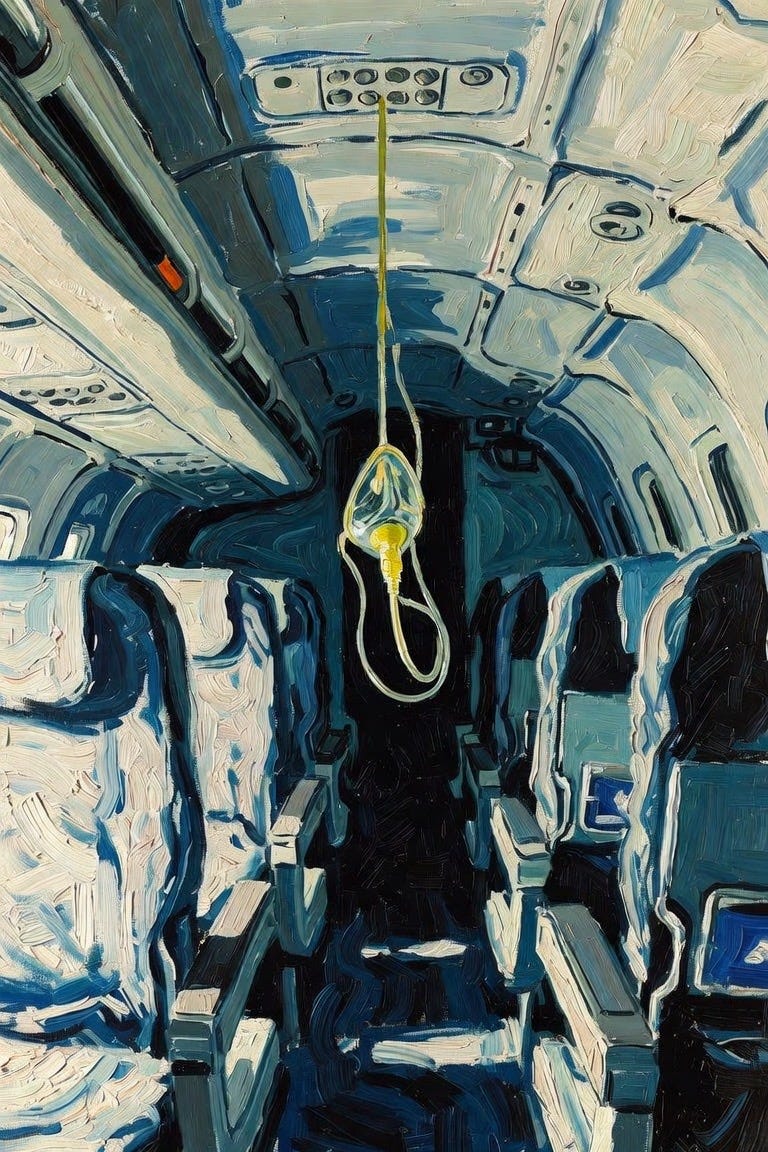
You know the instruction. You have heard it a hundred times without once listening, the cabin crew miming into the recycled air while you check your phone. In the event of a sudden loss of cabin pressure, a mask will drop from the panel above you. Pull it towards you. Fit it over your nose and mouth. And then, before you help the person beside you, before you reach for the child in the next seat: secure your own first.
It is the only safety briefing that ever escaped the aircraft. It lives on mugs now. On staff-room posters. In the mouths of kind people who want you to rest, who tell you that you cannot pour from an empty cup, which is the same idea wearing a cardigan.
And it is good advice. It is also a quiet lie, because of everything it assumes about you.
It assumes your hands work. It assumes you are awake enough to notice the mask has even dropped. It assumes you have the ten or fifteen seconds of useful consciousness the airlines actually plan for, and that you can spend those seconds lifting your arms above your head and pulling. It assumes there is oxygen in the line. It assumes the only thing between you and a breath is the small effort of reaching up.
It assumes you are not already the emergency.
Most days, that assumption holds. This is about the days it does not.
You know the feeling, even if you have never set foot in a hospital. It is the message you read and fully meant to answer and somehow have not, for nine days, while the guilt sets around it like cement. It is the second coffee you do not taste. It is being short with the one person who was being gentle with you, watching their face change, and not having whatever it would take to put it right. It is standing in the kitchen at some point in the evening with the fridge door open, not hungry, just looking, because looking into a cold lit box is the closest thing to a moment alone you are going to get tonight.
You are not lazy. You are not failing. You are running on a supply nobody is refilling, and you have grown so used to the low hum of it that you have started to think this is simply what being a person feels like.
It is not. It is the cabin, losing pressure. You have just been breathing thin air for so long that you have forgotten there was ever more.
Right to choose
Let me show you the purest version of it I know.
There is a person at the other end of a message who has reached the place most people only reach once. The place where you finally stop explaining it away and admit that something in the wiring of your own mind has never worked the way you were told it should, and you ask, out loud, for help.
They are spent before they begin. Thirty years of compensating will do that. The lists they wrote and lost. The alarms they slept through. The job held together with adrenaline and shame and a private terror of being found out. The friendships that quietly thinned because they meant to reply and the meaning-to was as far as it ever got, and from the outside that looks exactly like not caring. They have worn the mask so long it has fused to the face. And the thing that finally prised it loose was not strength. It was running out of road.
So I tell them about Right to Choose, because the NHS wait for an adult ADHD assessment here is measured in years now, and Right to Choose is the lever that gets them seen this side of the next decade.
And then I watch what we ask of them.
We ask them to research the providers and weigh them up. To find the form, download the form, complete the form, which runs to many pages. To score themselves, line by line, on how badly and how often they fail at precisely the things they are here because they fail at. To reconstruct a childhood. To produce a parent or a school report to vouch for a self they can barely narrate. To write the covering email. To chase it when no one replies. To carry the whole thing, for weeks, in a working memory that empties itself the moment they look away, alone, unheld, unreminded.
The test of whether you can manage long, self-directed, soul-destroying admin is a piece of long, self-directed, soul-destroying admin.
I have seen the form sitting open in a browser tab for four months. Still there. A small grey monument to exactly how much someone wants the help, and exactly how far out of reach we have placed it.
The door is built out of the one thing they came to tell us they do not have.
Everyone on the aircraft
Once you have seen it in one person you cannot stop seeing it in all of them.
The receptionist who took a faceful of abuse at twenty past eight, over appointments she does not control and we had already run out of, and who said good morning to the next forty people anyway in a voice already spent before nine. The colleague three doors down on her third clinic because someone went off sick, brilliant still, but tired in the way that brilliance starts to paper over, and who will not say the word struggling because the word has a bill attached that none of us can pay. The duty doctor carrying the whole building's risk in his head like a man carrying water in cupped hands across a long room, certain that the moment he hurries, he loses it.
Everyone is burned. Not dramatically. Nobody is face down in the aisle. That is the trap. It does not announce itself. It is a great many people all operating just below the line, each one certain they are the only one running on fumes, each one being told, gently, by a leaflet, a lanyard, a wellness webinar at lunchtime, to put their own mask on first.
As if the masks have dropped. As if there is anything in the line.
And then you go home
I am meant to be good at this. It is more or less the job. All day I am the oxygen for other people, handing it out in five and ten minute portions. A referral. A reassurance. A fit note. A kind sentence, placed carefully, for someone who has not had one aimed at them in a long time.
Then I drive home to someone whose body has been at war with itself for three years. There is a thin plastic line that runs up the inside of her arm and ends in a vein near her heart, taped flat, the place where it enters the skin kept under a dressing I have learned to change without letting my face do anything. The medicine that goes down that line is, in another room of the world, a poison. Some days she is well enough to be herself. Some days the illness simply takes the day, and there is nothing for me to do but be there, and not make it mine, and notice the half-second longer it takes her to stand.
She cannot help any of it. That is the part people leave out when they talk about caring for someone. The hard thing was never the tasks. The hard thing is the helplessness. It is loving someone straight through a thing you cannot fix, cannot hurry, cannot shoulder for them even for an afternoon. You can do every single thing right and the day still goes the way the disease decides.
And I see it. I see hers. I see the receptionist's, and the colleague's, and the patient's, going under in their own paperwork. I see all of it, all day, and seeing has never once been the same as being able to do anything about it.
That is the weight nobody warns you about. Not the carrying. The watching.
The altitude
So where is mine. Where is my mask.
Up there somewhere, in the panel above the seat, swinging on its tube with everyone else's. I know the brace position. I can recite the safety card from memory. I am exceptionally well informed about the importance of fitting my own first. I have read the leaflets. I have, God help me, written one or two of them.
And I still come home most nights with the gauge on empty, because you cannot give oxygen away all day from a tank that never gets refilled and then act surprised when there is none left for the people who share your name. Forty people at five minutes each, and it turns out forty fives is most of a life. There is a specific exhaustion that comes not from doing too much but from seeing too much. From being the one in the room who clocks every other person's depletion and is somehow expected to have a plan for it. You become a smoke alarm that never gets to leave the building.
Put your own mask on first. Fine. Show me where it is. Show me the oxygen.
And here is the part that should land somewhere behind your ribs, because you are on this aircraft too.
The masks have dropped. They are hanging there, swaying, above every single seat. Above the receptionist and the colleague and the man cradling water across the room. Above the person with the form still open in a tab. Above the woman with the line in her arm, and the man in the doorway who keeps quietly telling everyone else to breathe.
And the cabin has been losing pressure so slowly, for so many years, that not one of us feels short of breath any more.
We have decided this is just the altitude now.
I think this is the lesson from Ockenden. We get used to the degrading standards. Perhaps stop noticing them. Stop fighting them. Just plod on doing what you can in a organisation that appears not to care about you or your patients . I should say, I am not a Midwife but I can imagine their world having existed in similar.