

The Lull

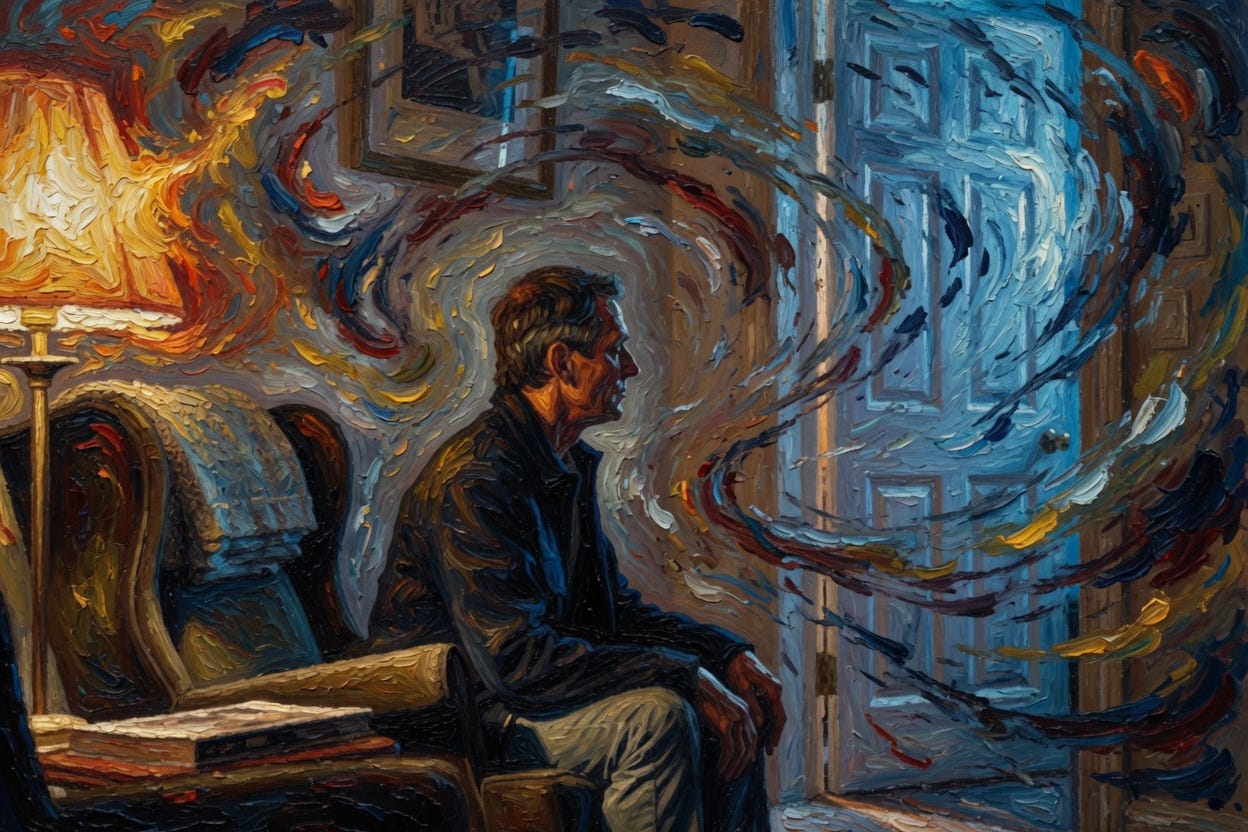
I am sat in a chair, alone. There is a slight tremor in my hands. My chest is tight. My mind is a maelstrom.
It’s back.
The shadow.
The body knows before the mind catches up. The body always does. There is something in the air that wasn’t here on Wednesday, or Thursday, and now it’s here, and the doors of the house feel closer to the walls than they did, and the kitchen doesn’t sound the same, and the dog is restless without knowing why.
Not a row. Not a crisis. Just a recalibration. The pressure has dropped.
The bargain
A week ago, maybe two, things had been quieter. Long enough that you stopped counting. Long enough that you started doing other things with the part of your brain that used to be doing the counting.
You don’t know exactly when the bargain happened. There was no moment. There was no decision. It just... arrived. Like the first suprise of flowers in the spring.
You found yourself making plans without the second draft. Booking a table without the mental backup option. Saying yes to a thing in three weeks’ time without first checking the inside of your stomach.
You let your shoulders drop a centimetre. Maybe two.
You started imagining a Saturday in June. Not as a hope. As a default. As the kind of thing that just happens to people.
That’s the bargain. You don’t realise you’ve made it until it breaks. You’ve traded vigilance for breathing room. You’ve put down some of the equipment you’d been carrying. The bag is lighter. The shoulders unknot. Something in you starts to think: maybe this time. Maybe we’re past it. Maybe the gap between flares is the shape of the future and not just a pause.
That is hope, although nobody calls it that.
That is the dangerous one.
The fluency
You become fluent in things other people don’t even know are languages.
You read the pause before the sentence. You read the second of silence after a question. You read the angle of the head, the choice of the chair, the way the mug is gripped, the change in the breath.
You read the sound the door makes at the back of the house. There is a normal way it closes. There is a small extra weight to the closing that means today is not normal.
You read the ten seconds after she comes downstairs. There is a rhythm to good days. There is a different rhythm to days where it’s already wrong.
You read what is in the kitchen at half past three. You read whose laughter is in the room and whose laughter is missing. You read the silence that arrives in the middle of a conversation and stays one beat longer than it should.
You read the dog.
And you read your own body, which has been keeping score this whole time, and which has begun, in the last hour or two, to send its signals up the line. The shoulders are wrong. The jaw is wrong. The stomach is wrong. The breath has gone shallow without permission, and the part of you that was making plans for June has gone very, very quiet.
The fluency does not go away. It just waits.
The tell
Then on Saturday, or maybe Friday evening, something turned. There wasn’t a thing. There was an air. There was a sentence said the wrong way, or said in the right way but with a thread of something underneath that has no name and that cannot be discussed without making it worse.
You pretended not to notice. You always pretend not to notice. Pretending not to notice is part of the equipment.
But the calculator had already come back online. The body had already opened the spreadsheet. The forecast was already redrawing itself.
By Sunday afternoon you were tracking three or four trajectories at once - what to say, what not to say, where to be, where not to be, who to keep out of which room, when to suggest food, when not to. You had stopped breathing all the way down into the bottom of your lungs. You hadn’t sat down for two hours. You weren’t aware of either of these things until it was Monday.
By Monday it was here properly. The thing you had hoped you wouldn’t see again. The shape of it familiar from the last time, and the time before, and the time before that.
The bargain had been called in.
The thing about hope
Here is what nobody tells you about hope.
Hope is not a comfort. Hope is an exposure.
Hope is what makes you put down the equipment. Hope is what climbs you up to a height. The fall is always from the height, not from the ground. The ground does not hurt to fall on. The height does.
Ready mode is exhausting. Ready mode wears the body down at the joints. Ready mode is what makes the shoulders set and the jaw clench and the sleep go shallow and the mornings start two hours before you wake up.
But ready mode is the bunker. Ready mode is the thing that means when the air shifts you don’t fall. You re-enter. You do the work. You hold the line.
Hope dissolves the bunker. Hope takes apart the walls one stone at a time, quietly, when you’re not looking, because hope has nothing else to do. Hope sees a wall and assumes the wall is no longer needed. Hope is in a hurry to get the rebuilding done.
And then the shadow comes back, as the shadow always comes back, and the wall is in pieces in the garden, and you are climbing back into a bunker that is no longer there.
This is what hope costs.
The shadow itself is not the problem. The shadow has terms. The shadow comes, the shadow goes. You can plan around a shadow.
The thing that broke is your readiness. The thing that wounded you is the lull.
Tuesday
The chair is the same chair. The tremor is the same tremor. The chest is the same chest.
What’s changed is the room around it. The walls have gone back up at speed, but they are thin. The fluency is back, but it is rusty. The calculator is open, and you’d forgotten how loud it is when it’s not.
From the outside, nothing has happened. There is no sentence you could say to anyone that would describe what the last seventy-two hours have done to your nervous system.
You sit. You wait. You let the body do its shift work.
Outside, somewhere, a dog is barking. The kettle clicks off. A car goes past.
The lull is over.