

The Drawer

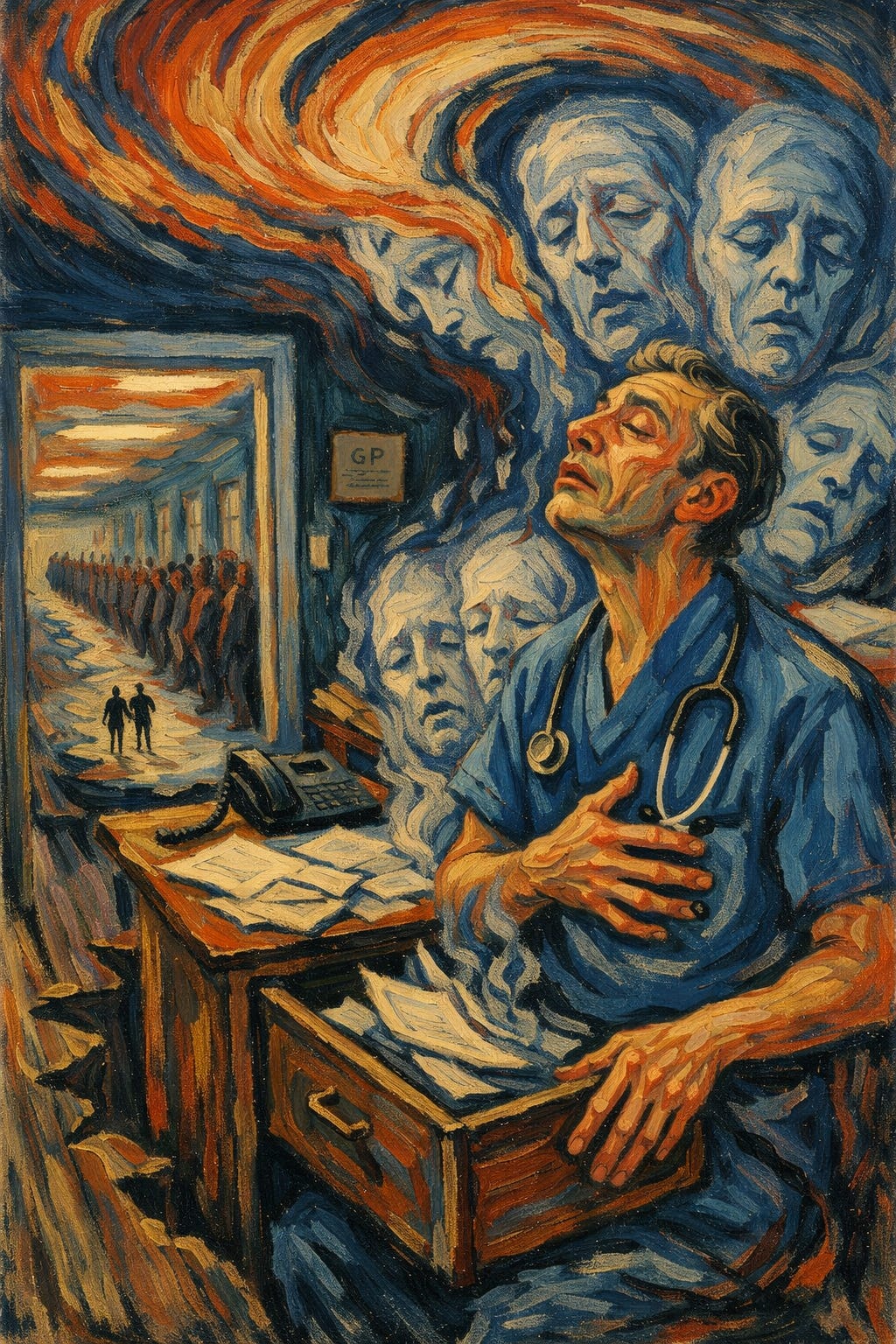
There’s a moment just before you say it.
Not the saying. The just-before. The breath you take when you already know what’s coming out, and the patient doesn’t yet, and for one second the room is still holding both possibilities. The one where there’s something you can do. And the one where there isn’t.
That second is its own kind of violence.
I’ve been trying to find words for what happens in my body in that moment. Not the professional version, not the language I’d use in a reflective log or a supervision. The actual physical experience of it. Because it isn’t abstract. It isn’t disappointment or fatigue or any of the careful words we reach for when we’re describing this to people who haven’t lived it. It starts as pressure. A tightness behind the sternum, like something building that needs to get out and absolutely must not. The knowing arrives before the words do. Then comes the swallow - not voluntary, not chosen, something deeper and more animal than that - and with it the shutters come down, and the feeling goes somewhere I can’t reach, and I am still sitting in the room being useful, and the patient’s face is doing the thing that faces do when hope has to become something else, and I am watching it from behind glass.
Then I call in the next patient.
I wrote once about standing on a cliff.
About the hot wind, the erosion, the way general practice has become a shrinking ledge between frightened people and a system that keeps retreating. The way we absorb structural failure because we’re the last surface available - the bit that still answers, that still has to look someone in the eye and say something back.
But the cliff at least gave you somewhere to stand. You were battered, singed, salt-raw. But you were there, on ground you recognised, leaning into weather you could name.
That ground has gone.
Not eroded. Not dramatically collapsed. Just - gone. You look down and there is nothing. No pathway. No referral. No service with an opening. No community team, no consultant who’ll take a call, no TWIMC letter that still moves anything. The place you used to be able to send someone when you ran out of road. The rope you used to be able to throw. All of it gone, or so hollowed out it amounts to the same thing.
The cliff isn’t a cliff anymore. It’s just air.
And when there’s only air, you fall with them.
That’s the part I haven’t written before. Not the erosion. The fall. The way you watch someone go over the edge and you follow, because there is no other honest place to be. You can’t stay on solid ground that no longer exists. You can’t hold out a rope that isn’t there. All you can do is go over with them, say the words, watch the face change, swallow.
And then the shutters.
And then the next patient.
I don’t know when I stopped processing these moments. I’m not sure I ever started. There’s no drive home long enough, no session quiet enough, no gap in the day wide enough to open them up and sit with them properly. You can’t, anyway. You know, in the way you know things in medicine you’d rather not know, that if you let one in fully you’d have to let them all in. And the arithmetic of that is unsurvivable. You’d be on the floor.
So instead you do the only thing available: you swallow, and you put it somewhere.
Everyone has a messy drawer. You know the one. The kitchen drawer, or the study one, or the one beside the bed you keep meaning to sort. Old batteries. Instruction manuals for appliances you don’t own anymore. A birthday card from someone who is gone. The detritus of living that has no category and can’t be discarded, so it just sits in there in the dark, waiting.
You don’t go in voluntarily. You keep adding to it because the alternative - sitting down with the whole mess and deciding what it means - is not possible right now, and right now keeps being now.
Open. Deposit. Close.
I want to be clear about what that is. The swallow, the shutters, the drawer. It isn’t weakness. It isn’t avoidance in the clinical sense. It is load-bearing. It is the mechanism by which a person does this job across a career without coming apart at the seams in the room where someone needs them. It is functional. It is, in its way, a form of professionalism.
But the drawer gets heavier.
You can’t weigh it. You can only notice it sideways. A flatness that wasn’t there a few years ago. A flinch at the wrong moment. A Tuesday afternoon that costs more than a Tuesday afternoon should. The drive home that used to decompress you and now just delivers you, still carrying it, to the next thing. The way you’ve learned not to think about what’s in the drawer, and the slow cost of that not-thinking, which you also can’t quite name.
There’s a patient I think about sometimes, though I won’t think about them directly. They are in the drawer. They came in several times over many months, worsening, waiting, falling through gaps I’d been trained to believe were narrower than they turned out to be. At the end of each consultation I was doing the thing that has quietly replaced medicine in too many rooms: containment. Another small adjustment. Another safety-net. Another “come back if it gets worse” that we both knew wasn’t really a plan - it was a holding posture, a way of staying present to something I couldn’t fix.
And eventually I had to say the thing. There is nothing. Not right now. Not in any timeframe that helps you. I have looked, and the rope isn’t there.
The face changed in the way faces change.
And I swallowed, and the shutters came down, and I called in the next patient.
They are in the drawer. There are others.
I don’t know what to do with that, and I’m aware that saying so out loud is its own kind of fracture. Because the only two stories we’re allowed are resilience or breakdown. The clinician who finds meaning in the impossible, or the clinician who collapses and becomes a cautionary tale about self-care. Neither is quite true. Most of us are doing something harder and less dramatic than either: continuing. Showing up. Swallowing. Adding to the drawer.
Not because we’re broken. Because we’re not, yet, and we’re trying to stay that way long enough to be useful.
But the drawer fills up. That’s the thing nobody says out loud. The swallow is not nothing. The shutters come at a cost. And somewhere underneath the flatness, the flinch, the Tuesday afternoons, there are all the faces. All the rooms. All the moments of falling.
Not processed. Not gone. Just in there. In the dark.
Waiting.
The cliff is gone. The ground has disappeared. And we are all - patients and clinicians both - falling through the same air, trying to trust the drop is survivable.
Most days it is.
And most days, you swallow, close the drawer, and call in the next patient.
That’s not resilience.
That’s just what it is.
Beautiful writing about a load so seismic for all of us in this system called life but specifically this creaking-at-the-seams NHS, which can barely bear its load anymore. You make the intangible real through your beautiful poignant writing. Thank you and with great feeling for all that you and your colleagues have to bear the load of, stashed away from view, but seeping in on your enduring commitment and competency and capability every single day. I wonder if Wes Streeting reads “Waiting Room Whispers?” I assume not… and would he feel it’s emotional resonance if he even did…