

The Bunker

The film
Twenty-two hundred. Plywood. Canvas. A laptop balanced on a Bergen and Old School playing for the third time that month. Will Ferrell streaking down the street. Vince Vaughn shouting after him. Someone laughs. Someone passes a packet of biscuits.
The crump arrives somewhere outside the wire. Close-ish. Closer than last time, maybe. Hard to say. We have stopped being good judges.
There is a debate, briefly. Bunker or stay. The bunker is fifty metres of dark gravel away. The accommodation is plywood and canvas, which is to say nothing at all if a round lands on it. We sit in body armour and helmets. We watch Will Ferrell streak. We pass the biscuits. The film does not pause.
This is month six. The debate has lost its edges.
In month one we ran. We ran in flip-flops and t-shirts and we sat in the bunker until someone with more time in country said you can come out now. In month three we walked, body armour pulled on as we went. By month six the bunker is for other people. By month six we are sitting in helmets indoors, watching a 2003 frat comedy, treating incoming as weather.
A round lands. Someone says fucking hell, lads.
Nobody gets up.
The thing nobody tells you about a soft-skinned tent under indirect fire is how quickly it stops feeling soft-skinned. You learn its sounds. You learn the difference between outgoing and incoming, between mortar and rocket, between something that has landed in the wire and something that has landed somewhere over there. You learn what a 107mm sounds like when it doesn’t go off. You learn to keep eating.
You’re not brave. You’re just trained. By repetition. By the slow erosion of the part of the brain that should be flinching.
The bunker is still there. Sandbags on a corrugated roof, HESCO walls, a single bulb wired to a battery. We could go. We don’t. The threshold for going has moved without anyone agreeing to move it.
It takes a Tuesday in February for me to think about it again.
The reassurance
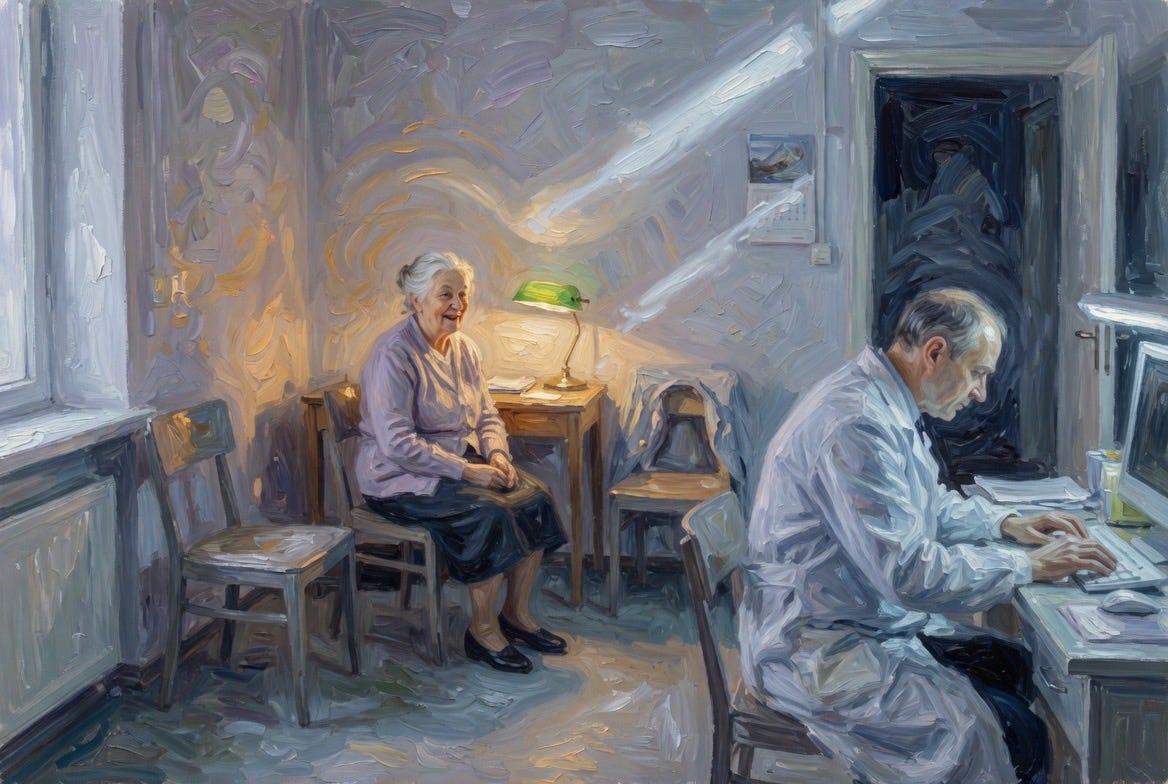
The consulting room is warm. A woman, seventy-eight, her shoes neatly together under the chair. I have just told her the service she needs no longer exists.
This is not a misunderstanding. It is the truth. The community pathway she was referred into eight months ago has been quietly decommissioned. The replacement has a sixty-four week wait. The interim option, which would have done at a push, has been removed in the most recent commissioning round. There is, at the practical level, nothing.
I am working out how to say this when she says it for me.
That’s the way it is. Don’t worry.
She says it kindly. The way you might say it to a child who has dropped a glass.
I feel something old and unwelcome land in my chest. Not anger. Not exactly. The feeling of being absolved by the wrong person. She is reassuring me. She, with the hip that wakes her at 3am and the stairs she has stopped going up and the daughter who has stopped asking when it will be sorted, is reassuring me. She is the one in body armour. She is the one who has stopped flinching.
I want to say no. It is not the way it is. It is the way it has become. We did this. There is a meeting somewhere where this was a line item. This is not weather.
I don’t say any of that. I say something professional. I write something in the notes. She gets up, slowly, and she thanks me, and she walks out.
The next patient is also old, also waiting, also apologising for taking up my time. So is the one after that. So is the one after that. They are queueing up to reassure me that a system which is failing them is fine. That’s the way it is. Don’t worry. We’re not really expecting much. We know you’re busy.
You learn to keep going.
You learn the sounds of what is landing. Sixty-four weeks for a hip. Eighteen months for a knee. Two years for an autism assessment in a fourteen-year-old. A community service quietly removed without notice. A specialist clinic absorbed into the trust and never reopened. A line in a commissioning report you have to read twice to understand what has been taken away.
You learn what an absence sounds like, in the same way you learn what a 107 sounds like when it doesn’t go off.
You learn to keep eating. You learn to keep prescribing. You learn to keep typing into the box.
The bunker
Here is the thing about the bunker.
In Kandahar there was one. Sandbags and HESCO and a single bulb. We didn’t go, because the threshold had moved. But it was there. If a round had come through the tent we would have been able, in the moment before it mattered, to say we should have gone.
There is no bunker on the NHS side.
There is no fifty-metre dash to a sandbagged structure. There is no place we could have gone. The patient with the sixty-four week hip cannot retreat to a hardened shelter. Neither can the receptionist who took the call. Nor the practice manager who wrote the apology letter. Nor the GP who tried to explain why the service was gone. The accommodation is soft-skinned all the way down. There is nothing harder behind it.
What we have, instead, is the slow recalibration of what counts as a hit.
Eighteen months ago a sixty-four week wait would have stopped the room. We would have written letters. We would have escalated. The body would have flinched. Now I say it on a Tuesday morning and she says don’t worry and we move to the next thing.
You’re not numb. You’re just trained.
A 78-year-old has built it into her sense of the world that this is what services do now. Her job, as she sees it, is to make it easier on the doctor. I have a hundred more sentences like hers queued up, in inboxes and waiting rooms and WhatsApp messages from colleagues. Nobody is running. Nobody has run for some time.
In month six in Kandahar we watched Will Ferrell streak, in body armour, while incoming landed in the wire. We thought we were coping. We were. The threshold had moved underneath us without our permission.
I think about that tent more than I used to. The way the canvas moved when a round landed close. The way nobody flinched. The way Frank the Tank kept running, pale and half-cut, down a suburban street, while we sat there in helmets and pretended the building we were in was a building.
The patient leaves the consulting room. The notes are written. The next name comes up on the screen. Outside, somewhere, a system is landing rounds. We sit in our body armour. We do not get up.
That’s the way it is.
Such a good analogy.
Brilliantly written again. Using something as relatable as Frank the Tank put me there. As a civilian I cannot imagine the rest... You mention you are not brave, just trained. I beg to differ