

The Beggar

Over the bank holiday weekend I sat up late with an old friend, a man I have known since before either of us was anything at all. We met at Sandhurst, a long time ago, at the age when the army is still busy convincing you it is making you into something. He went one way afterwards and I went another. By routes that neither of us, as young men, would have drawn on any map, we both ended up as doctors.
His half of the story is the better one. He has spent years doing the kind of medicine that gets done in hard places, on operations, with bad things happening within earshot. He has more to tell than I ever will, and he tells it better, and I am content to pour the drinks and let him.
We were talking late, in the way you can only talk with someone who knew you before you were finished. He was describing what it is to come back. To set down operational medicine and pick the ordinary working life of the NHS back up. And somewhere in the middle of it, not slowing for it, not marking it as anything, he said three words.
You can’t feel.
He said it the way you would mention a fact about a new houseplant he’d bought. Something settled, learned a long time ago, no longer worth any heat. He laid it on the table between the glasses and carried on.
I did not carry on with him. I had stopped a sentence or two back, on those three words, because they had gone in cleanly, and I had recognised the wound before I had finished taking it.
The man on the floor
A few days later I was crossing the concourse at King’s Cross.
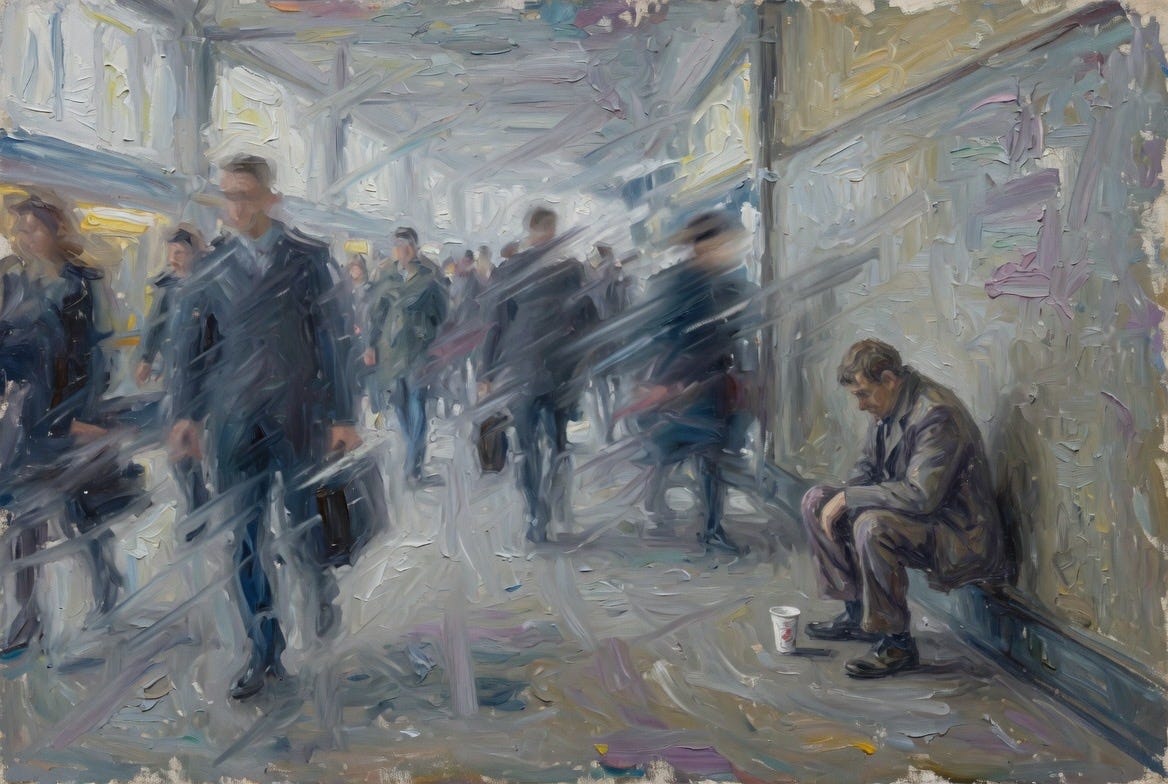
It was mid-morning, and the place was doing the thing it does, several thousand people each privately certain that they were the one in a hurry. Near the mouth of the Underground a man sat on the floor against the wall, a paper cup in front of him and a square of flattened cardboard beneath him, holding the particular stillness of someone who has learned that stillness, at least, costs nothing. As the crowd went by he was wishing it a good morning. Not asking for anything. Not aiming it at anyone. Simply offering it up to the concourse, to all of us, the way a man might if he had decided the day deserved the courtesy whether or not the day had earned it.
I walked past him.
I did not decide to walk past him. There was no moment in which I weighed the man and judged him not worth a coin or a minute of the morning. My legs simply never received the instruction to stop. My eyes had already gone to the middle distance. Some practised muscle of the attention took him in, sorted him, and steered me smoothly around him, and it had done all of that and carried me four clear steps beyond him before the thinking, deciding part of me was consulted at all.
That is the part I have not been able to put down. Not that I gave nothing. That I never arrived at the point of choosing. On the floor of a railway station, in under three seconds, without my permission and very nearly without my knowledge, I had triaged a human being. I had taken his whole life, and his good morning, and filed them somewhere near the bottom of a list, and walked on.
And this is the thing that has kept me awake. I am extremely good at that. It is, more or less, the job.
The practice I work in runs on triage now. Each morning a column of human trouble arrives on a screen, every line a name and a sentence of difficulty, and before a word of medicine is spoken the first work of the day is to read that column and rank it. Sickest at the top. The rest set out beneath, in the order I have judged their pain can bear to wait. I am fast at it, and I am good at it, and the whole system leans on my being both. Nobody calls it walking past anyone. They call it prioritisation. They call it efficiency. Done well, they call it professionalism, and they are right to, because there is no other way a day like that gets survived.
The last patient I saw before lunch that week was a woman in her seventies with a knee that had started to fail her. She had come, correctly, near the foot of my column, because a knee will not kill anyone and the column knows it. She apologised, twice, for bothering me with something so small. It was not small. It was quietly deciding which rooms of her own house she was still allowed to enter. To her it was the entire sky. I was kind to her, and careful, and I also handed her, if I am honest about it, a thinned and rationed portion of myself, because there was still a column to get to the bottom of and a weight of my own sitting in the room, and you cannot, you genuinely cannot, feel all of it.
That is what my friend meant. That is the wall the whole job is built upon. Let yourself feel it at full strength, every patient, every name in the column, the man on the floor, the news, the entire bottomless need of the world, and no nervous system ever issued could carry the load. So the deadening is not a fault in you. It is issued to you, like kit. It is protective equipment. And it protects you the only way equipment of that sort can, by putting something between you and the world, and the something it puts there is your own capacity to be moved.
I became a doctor in order to be moved. So did he. Being moved by people, and moved enough to act on it, was the whole substance of the thing. And the first quiet instruction of the work, its load-bearing wall, is that you must not be. To keep doing the thing you were called to do, you betray, a little, every day, the thing that did the calling. It has an older name than burnout, a soldier’s name, and the two of us were handed it long ago, in the same classrooms that taught us how to carry a wounded man off a field. Moral injury. Nobody mentioned, at the time, that we would mostly be using it on ourselves.
What you cannot put down
There is a question I have caught myself turning over on the worse days. Whether the weight I carry in to work is, in the end, heavier than the weights I am paid to lift once I am there.
I cannot answer it. The reason is not modesty. I have a weight of my own, and I know that it is there the way you know there is furniture in a darkened room. I can put out a hand and find its edges. What I cannot do is feel its size, because the wall I built to get myself past the man on the floor, I built that wall facing inward as well. I triaged myself a long time ago. Not to the bottom of the list. Off it entirely. With precisely the same automatic, unconsulted motion as my legs at King’s Cross.
There is one place the wall will not stand.
That same morning, in the ninety seconds between two patients, I had been messaging home. Was she awake. Had the car taken its charge overnight. Had she found the badge, had she eaten something, because there are days that simply have to be got through, and getting her safely to the start of one is a small campaign run from my phone in the gaps between other people’s emergencies. For her, there is no deadening on offer. The wall I can raise without effort or thought against a station full of strangers and a screen full of the sick will simply not stand at my own front door. That is the mercy of it and the cruelty of it, folded into the same sentence, because the one person I have never once managed to stop feeling for is the one whose hurt is the closest, and the longest, and the least mendable of all. I do not get a say in where the wall holds. It holds where it holds.
So I cannot hand the kit back. Tomorrow there will be another column, and it will need me fast and good and a little deadened, and I will be all three. My friend was not wrong. You can’t feel, not all of it, not in the moment it is in front of you, not and still be upright at the end of the day.
But I have been turning his three words over for a while, and I do not think the sentiment was entirely right either. If it were true the whole way down, the words themselves could never have wounded me. They did. I went quiet. They lodged. Something behind the wall was still awake enough to be hurt by the news that the wall was there.
I did not stop for the man at King’s Cross. I have not managed to leave him behind me either. He has come the whole way with me, from the concourse to the consulting room to my own kitchen and now onto this page, and I have finally worked out what that is. It is the feeling, arriving the only way it is still permitted to arrive. Late. Hours late. Days late. Long after the man has gone and there is nobody left to give it to. It does not stop. It only runs in arrears.
He wished the whole station a good morning, and not one of us broke step. It has taken me three days to hear him. This is me answering, three days late, and in the wrong direction, on a page he will never read.
These stories hold such beauty and such sadness. I hope you can stop from time to time to nourish your own soul, to ease the moral injury.
Sad but true. It took me half a career for it to register. To care well, you sometimes have to care less. Lovely writing again. Brutal, but lovely