

The Ashes

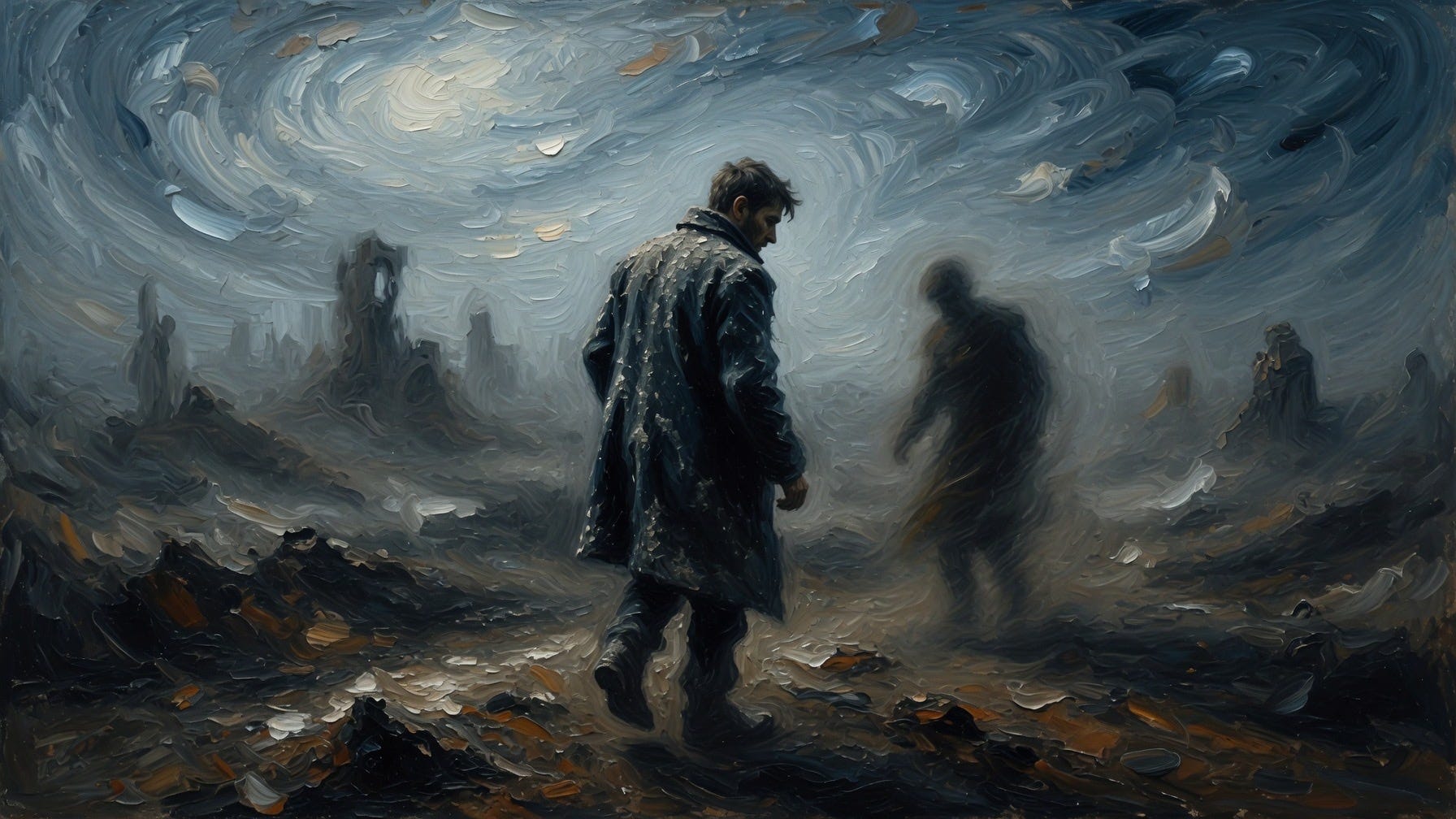
Ten past eleven on a Tuesday. The third referral of the morning, and the form on the screen has already told me how it ends. There is a field for the service he needs. The service is not commissioned within forty miles of where he lives. The letter, when it eventually comes, will be very polite about it. It will use the word criteria. It will thank him.
The room is too warm, the way these rooms always are by mid-morning, the radiator with no off switch and the window that opens four inches by law.
He doesn’t know any of this. He is leaning forward in the chair, both forearms on the edge of my desk, the way people sit when they have decided that today is the day something finally gets sorted. There is hope in the way he is sitting. Not spoken. Postural. He has been waiting for this appointment the way you wait for a verdict you have already decided will go your way.
So I tell him.
I watch it leave him. Not all at once. First the leaning back, a few degrees, the body retreating before the face has caught up. Then the eyes, doing the arithmetic, getting to the answer, refusing it, getting to it again. Then the small nod that isn’t agreement. It is the nod of a man being told that the ground he was standing on was never ground.
His condition is the kind that takes a life apart slowly and has no intention of stopping. I am not going to name it. You would recognise it, or you would think you did, and then you would file him away as a diagnosis, and he is not a file. He is a man who walked in this morning believing there was a next step, because every other part of his life has had a next step, and nobody had ever told him that this is the one place where the corridor ends in a wall.
The war already came
We talk about illness as if it is a war still being fought. The front line. The battle. Fighting it, bravely, to the end. The language assumes there is a line being held, and reinforcements behind it, and a plan being run by someone with a map.
I have spent the last fortnight telling people there is no map.
There is no clinic for this. There is no team that sits down on a Thursday with his name on a list. There is no number he can ring at three in the morning, which is precisely when the pain does the particular thing it does at three in the morning. There is no pathway, no protocol, no service specification, no box on any form that, when you tick it, makes another human being appear who knows what to do and is willing to do it.
There is the GP, who is me. There is the internet. There is whatever he can build for himself out of the wreckage.
I have said this, in some shape, to a woman whose body is doing something three consultants cannot agree a name for. I have said it to a man in his forties who has been told there is nothing more, surgically, that anyone is prepared to do. I have said it, this fortnight, more times than I have said almost anything else, including good morning. You learn to watch for the moment it lands. You get good at it, the way you get good at anything you do too often and wish you didn’t.
Nobody refers the person who does the referring. You go home quieter than usual and someone asks if you are alright and you say you are just tired, because tired is a word people accept, and the truer sentence is harder to say at the end of a day than at any other point in it.
The war is not coming. That is the thing nobody says out loud in the consulting room. The war already came. It came, and it was lost, in the quiet bureaucratic way that wars are lost now - not on a battlefield but in a commissioning meeting, in a budget line that was never drawn, in a service that closed in 2019 and was never replaced. The bombs fell years ago. We are just meeting the survivors one at a time, as they wander in, still dressed for a fight that finished before they got here.
Ground I have walked
I recognise the look on his face because I have worn it.
We have done our own walk across this ground. The detail is ours. But there were months when the next step was supposed to exist and didn’t, when the letter came back to say we did not meet the threshold, when the thing that was meant to catch us turned out to be a web form and a number that rang out. The kettle going on at two in the morning, because if you are both awake you may as well be awake together. The drug she takes now is one strong enough that the people who handle it before it reaches her wear gloves. There is no clinic on a Thursday for us either. We worked most of it out ourselves, in the kitchen, at the wrong end of the day - the way you assemble flat-pack furniture with a part missing and then decide the part was probably optional anyway.
And here is the thing I am not supposed to find comforting, and do.
What helped was not the system. The system was a polite letter. What helped was the others.
People who had been somewhere near this before. People who knew which door, in a building with no signs, occasionally opened. People who said the one sentence you most need to hear when you are standing in the ashes of a plan, which is not it will be alright, because they are not liars. The sentence is shorter than that. I know. I have been here. Mind that bit on the left, it gives way.
The ones still standing
You find them in odd places. A forum that looks like it was built in 2006 and never touched since, which is somehow still the single best source of practical information on a condition that has defeated three royal colleges. A WhatsApp group. A charity run out of someone’s spare room. A spreadsheet, passed hand to hand between people who have never met, listing which hospitals in the country will actually take this and which will only write back about criteria. A woman who got her diagnosis four years before you got yours and has turned the whole grim apprenticeship into a kind of competence, answering messages at midnight from strangers she will never meet, because somebody did it for her once and the debt only ever pays sideways.
These are not patients waiting for treatment. Somewhere along the line they stopped waiting. They emerged from the ashes, looked around, understood that no one was coming, and became something else. Soldiers, in a war that is, for a great many of them, quite literally about staying alive. The ones who make it through are, for now, alright. The ones who falter are not. There is no managed transition between those two states. There is just the fight, and whether your body and your luck and your homemade scaffolding hold.
And the strange, hard mercy of it is what they do with what they have learned. The ones who were close enough to be hit and survived turn round, while the dust is still in their own lungs, and start pulling the next ones out of the rubble. Nobody appoints them. Nobody trains them. They did not want the job. They got there first, that is all. And looking back at the figure stumbling out behind them, blinking, dressed for the wrong war, they find they cannot do the thing the system did, which was nothing.
I want to be careful here, because this is the part that gets lifted out and turned into something it is not. This is not a heartwarming story about community filling the gaps. The gaps should not need filling. A woman answering messages at midnight is not a service. She will burn out. There is no rota. The man a little further along carries the new one’s shock stacked on top of his own, and his own was already more than a body is built to hold. Leading people out of a fire while you are still burning is not a model of care. It is what people do when they have been abandoned and refuse, in turn, to abandon each other. There is a difference between those two things. The difference matters.
So. Back in the room, with the man who is no longer leaning forward.
I could not give him a service. There wasn’t one. What I gave him was a name. Two names, in fact, written on the back of a blank prescription, because the system has a box for drugs and no box for this. People who are further along. People still standing. The most honest referral I have made in a fortnight, and it appears on no record, generates no letter, meets no criteria, and will never once be counted.
He wrote it down. He held the piece of paper the way you hold something when it is the only thing you have been handed all day that feels like it might be load-bearing.
There is no lesson in this. I have looked for one. People keep wanting me to arrive at the redemptive sentence, the bit at the end where it turns out to have meant something, and I do not have it, and I am not going to manufacture it for the sake of a tidy finish.
What I have is the next morning. Another form, another field for another service that closed before the patient ever needed it. Across the desk, somebody I have not met yet is sitting down, putting both forearms on the edge of the table, leaning forward.
Still dressed for a fight that is already over.
Still certain there is a next step.
And me, already working out how to show them exactly where the ground gives way.
I feel that "liking" this post is entirely wrong - chiefly because you shouldn't have to be carrying this burden. The specialty that is the one failing to provide the needed service should be explaining, leaving you to be the "good guy" saying what you can/can't do forbtour patient. The House of Commons Health Committee is led by the splendid Layla Moran and I am very tempted to find a way to direct her and her committee to your substack - the real insights to life as a GP in England these days needs to be brought to their attention.
On a personal level, long ago, even before my GP surgery went electronic I realised I was on my own with my "complex comorbiditiedls". My few GP appts since 2021 have been phone calls with strangers who just want to talk about the thing I've mentioned on the electronic request ("my" wonderful GP who was my point person since my medical problems developednl during 2006 sadly died last year, just months after being diagnosed with cancer). The specialty doctors I do still see occasionally (or have a telephone appt with) are, rightly, focused on the bit of me that they're interested in, but that's it. I remain pleasant and optimistic in all these encounters, just in case something occurs to one of them that might be helpful for me, and to make it clear that I'm still in the game and am not ready to be sidelined -I am lucky I am me!
Again I really hope you have someone good to talk these burdens through with (a professional someone) as, in combo with everything else on your plate, you need to be able to release the intense pressure that you, and I suspect many a GP across the country, are under.
{{{hugs}}} 🌷
Hello Dave
Thank you for writing. Your life sounds exhausting and draining, but you stay compassionate and thoughtful and that gives everyone hope.
Sadly, I don’t think the battle was ever even fought in those commissioning rooms. We all rolled over. Everyone was so keen to be constructive, helpful, maintain their position, or move up the ladder or just believe that this wasn’t the war it was. That more could be achieved with less, that we’d all been old fashioned, uneducated and new ways, that were not so new, would fix the gap and services would improve rather than wither away. That delivering something was better than delivering nothing. I speak as someone who was in those rooms, as a voluntary sector partner, who did my fair share of we can make this work, of bright smiles and gulping down the sensible protestations which would be heard as cynicism and bitterness.
It wore us out, the dissonance, the trying to make things work, the shrinking pots of money and the growing demands, the holding lines that became forever fainter. And so here we are with a safety net so tattered most fall through its holes.
Thank you for telling all of this but also that it wasn’t always like this. That we have lost something. So many people now, don’t know that our world wasn’t always so. That there weren’t always foodbanks; that Home Helps once did more than basic care, that community centres, adult education, day centres and services all existed, and GPs and police weren’t spending their time mopping up the results of this lack. All of these services were imperfect but they were there, and in a country not as rich as it currently is.
I’m wishing you an easy Thursday. Best wishes.