

Technicolour Brain Explosions

The Word
Tuesday morning. Room one. The one with the blind and the window that doesn’t quite close. There’s a coffee going cold next to the keyboard and a stack of paperwork I’ll get to later and a patient sitting across from me telling me something that should be routine.
Then they say a word.
I’m not going to tell you the word. It doesn’t matter. What matters is that it doesn’t land where it should. It doesn’t drop into the tray marked “straightforward” next to the safety-netting and the follow-up in four weeks. It drops somewhere else. Somewhere deeper. And it detonates.
Two seconds. That’s what the room sees. Two seconds of a GP looking like he’s thinking. Maybe listening carefully. Maybe about to say something reassuring.
I am not about to say something reassuring.
What happens inside those two seconds is not thinking. Not the way people mean it. There is no orderly chain of logic, no A-leads-to-B-leads-to-C. What happens is the lights come on.
All of them. At once.
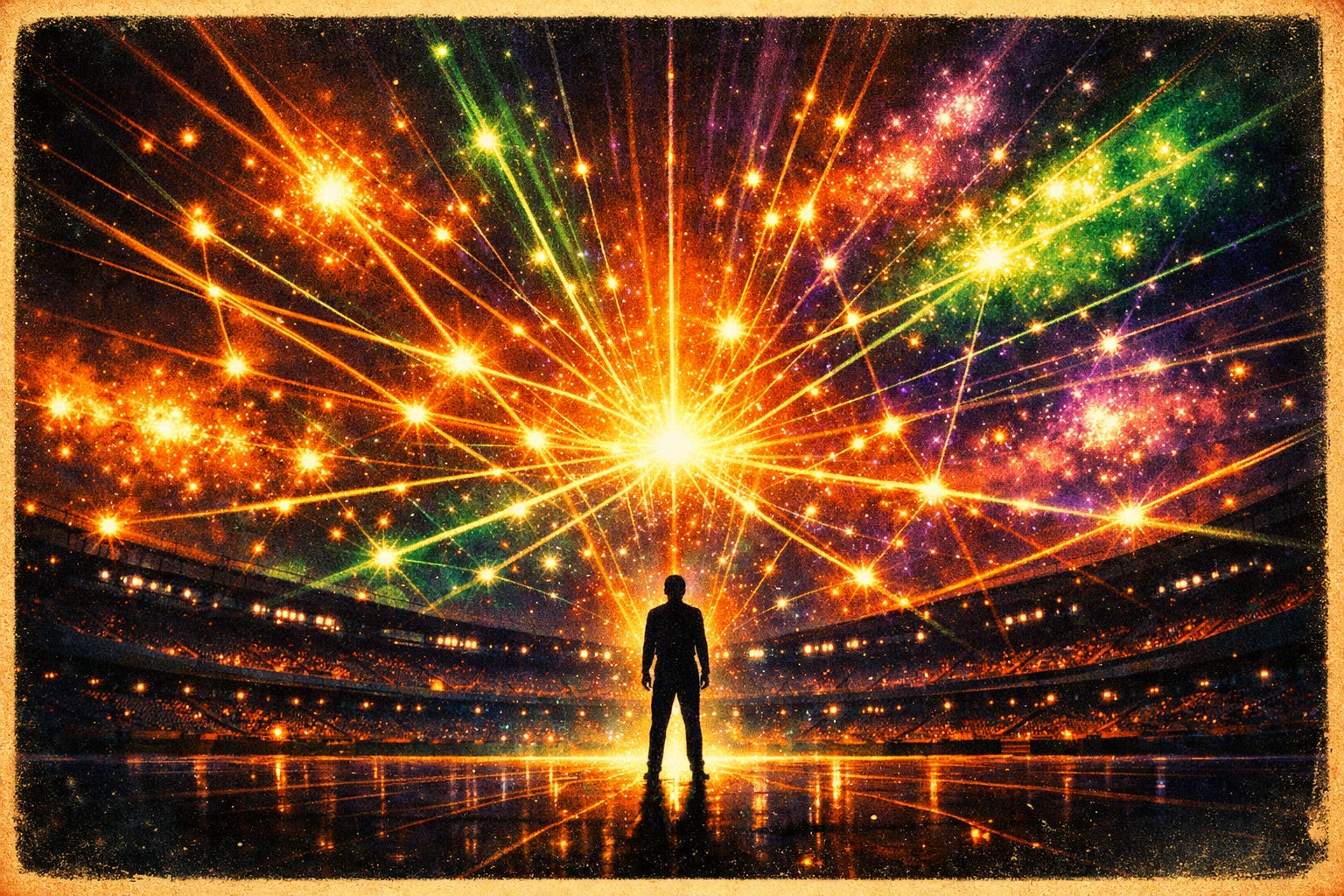
Imagine a dark warehouse the size of a stadium. Now imagine every surface is a screen. Floor, ceiling, walls, all of it. And someone just hit the master switch. Suddenly there is colour everywhere. Not neat colour. Not organised colour. Explosions of it. Hot bright streaks connecting things that have no business being connected. A blood result from six weeks ago flares amber in the upper left and throws a line, an actual burning filament of light, across to something I read on a train in 2017. That lights up green and kicks out three more threads, one to a lecture I barely attended a decade ago, one to a conversation I had in a field in another country in another life, one to something this patient said eight months ago that nobody followed up because why would you. Each of those nodes ignites and throws out its own connections and now the whole stadium is alive. Pulsing. Streams of colour crossing and intersecting, some bright and sharp, some faint, some flickering like they’re not sure yet. Clusters of memory forming, coalescing like slow galaxies, pulling fragments together into shapes I don’t have names for yet. Images, textures, half-sentences, a diagram from a textbook I owned fifteen years ago, the expression on a colleague’s face when they said a thing they didn’t know was important. All of it moving, organising, rearranging itself. Not chaos. That’s the bit people get wrong. It looks like chaos but it’s architecture. The blobs of memory finding each other, sorting themselves by a logic that is entirely real but entirely mine, and the picture emerging is not the picture anyone else in this room would see.
Two seconds.
The lights settle. The architecture holds. And one thread, one bright burning line, runs from the centre of the whole constellation to a question nobody has thought to ask.
I ask it.
The patient looks confused. That’s not what we were talking about.
We were never just talking about what we were talking about.
The Screen
Nobody sees the screen. That’s the thing. From the outside it looked like a pause. A moment of careful thought. Maybe instinct.
It is not instinct. It is a stadium running at full power and you are standing in the middle of it and the only exit is a sentence. One clean, confident sentence that translates ten thousand simultaneous connections into something that fits inside a consultation. So you find the sentence. You say it. Everyone nods.
And you can never show them what was behind it. Not because it’s secret. Because it doesn’t translate. The architecture of the thought is so dense, so cross-referenced, so dependent on a throwaway remark filed next to a half-read abstract filed next to a colour you saw on a wound that reminded you of a painting that reminded you of a phrase that reminded you of the exact pathway that just sent this patient’s referral to the right place instead of the wrong one. You cannot flatten that into speech. Language is linear. One word then the next then the next. The thought was not linear. The thought was a room full of light and it happened all at once and the best you can do is pick one bright thread and hold it up and say “this, I followed this” and hope no one asks how you got there. Because “how I got there” is a forty-minute journey through an immunology paper I skimmed in 2019, a patient I treated in a country I don’t talk about much, something someone said last Tuesday that didn’t mean what they thought it meant, and the particular way this person’s face just moved without them knowing it. That is not a clinical reasoning chain. That is a brain that never learned to turn the lights off.
Autistic. ADHD. Two labels. Both wrong in the way that a photograph of a bonfire is wrong. Technically accurate. Missing everything that matters. The heat. The colour. The way it moves.
The Hum
The stadium doesn’t close when I leave the building.
I’m cooking dinner and the oil hits the pan and the sound connects to a frequency that connects to a monitoring alarm that connects to a deployment that connects to a kid’s face that connects to a safeguarding case from last month and now the seasoning is burning and someone is asking me something and my hands are in the kitchen but the rest of me is in the stadium, watching filaments fire between things that happened years apart on different continents, and I have to physically pull myself back into the room like hauling a rope out of deep water.
It runs in meetings. Ninety seconds in, the screen has already assembled the answer. I can see it. Burning bright in the centre of everything, obvious, done. And the room is going to walk there on foot. Thirty minutes of linear conversation converging on the thing I am already standing on top of. And I can’t say that. So I sit. And the screen doesn’t wait. It starts building something else. Solving the next problem. And the next. By the time the meeting ends I have designed something three months away inside my head and also I could not tell you what the last four agenda items were because the stadium was showing me something more interesting and I could not look away because you cannot look away. There is no away. The screen is not in front of you. The screen is you.
Everything is input. Not just words. The texture of the chair against my arm. A temperature shift when a door opens two rooms away. The micro-expression on a colleague’s face that tells me something they don’t know they’re broadcasting. All of it streams in, unfiltered, unprioritised, a flood of data that the architecture tries to sort and cross-reference in real time while I am also supposed to be having a conversation and making the right amount of eye contact and not mentioning that I can hear a light fitting buzzing at a frequency that is making my skin crawl. Every surface of the stadium is receiving. Every surface is processing. Every surface is connecting the incoming to everything that came before.
People ask how I think so fast. I don’t know how to think slow. There is no dial. There is no setting between the full stadium and silence, and silence is not available. It is a kind of flight, if flight meant you could never come down. If the sky was beautiful and enormous and you could see everything from up there, the whole landscape lit up and connected, and the only cost was that your feet never touch the ground.
The Car Park
The consultation went well. The referral went to the right place. The word did what it did and the screen fired and the architecture held and this person will probably be fine because of two seconds of something that looked like a pause.
I’m sitting in my car with the engine off.
The stadium is still running. Seventeen things on the screens right now. The call I haven’t made. A pattern in someone else’s bloods I haven’t acted on yet. A sentence from a book I read four years ago that has attached itself to something I can’t identify. The way someone looked at me in the corridor today that might have meant something or might have meant nothing and I will run it through the architecture for three days until it resolves or doesn’t.
This is the technicolour brain. The one that detonates and connects things that have no business being connected. The one that sees the constellation before anyone else sees the stars. It is also the one that is sitting in a car park at six o’clock, engine off, hands on the wheel, running a stadium of light with no audience and no off switch and no way to explain to anyone what it costs to see in colours that other people don’t have names for.
The engine starts. The screen keeps rolling.
Tomorrow there will be another word.
There always is.
You “see the constellation before anyone sees the stars”. Powerful. Seeing. Pausing. Listening. Finding the next step. Incredible. Thank for taking the time to share here. Love your writing. 🤗