

Sorry

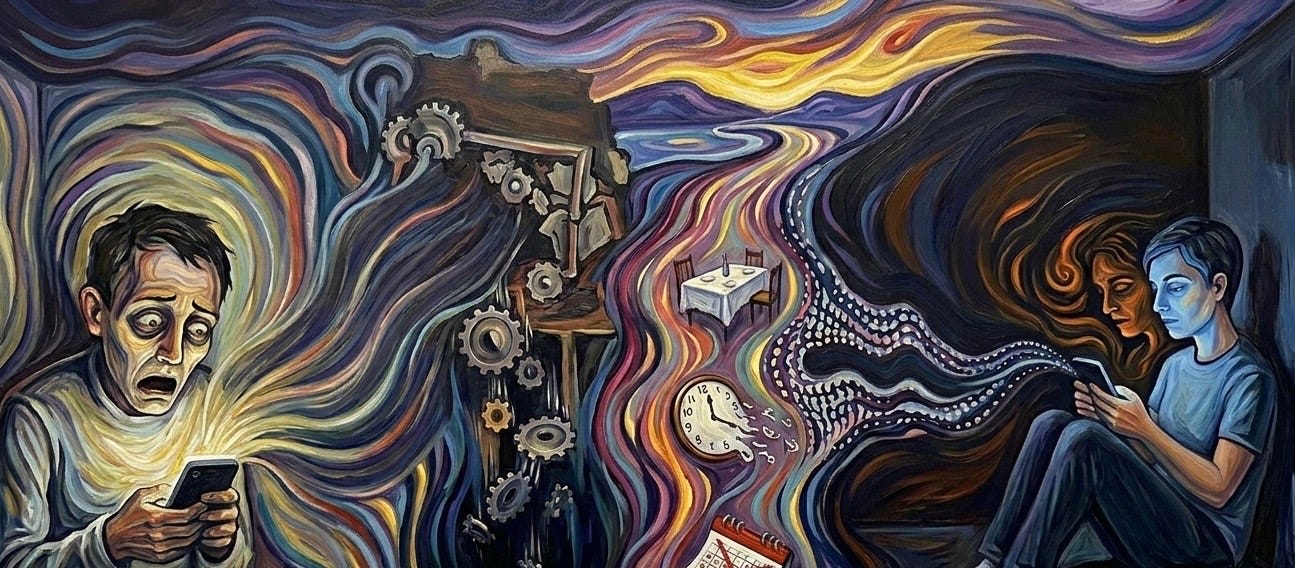
The text takes longer to write than it should.
Not because the words are complicated. They are the same words as last time, arranged in the same order, doing the same job. “I’m so sorry. She’s not well enough tonight. We’re going to have to cancel. I’m really, really sorry.”
The really, really is new. An escalation. As though intensity of apology might compensate for frequency.
You read it back. You change a word. You change it back. You send it before you can find a better version, because there isn’t one, and the restaurant booking needs cancelling and someone is sitting at home in the dark waiting for a day that turned out to be a bad one.
Then you watch the screen.
The three dots appear.
They stop.
They appear again.
And then: “Of course, don’t worry at all. Hope she feels better soon. We’ll rearrange.”
It is kind. It is genuinely kind. And in the two seconds between the dots stopping and the dots starting again, you learned everything the message was too decent to say.
What the word is for
Sorry is a machine with a specific function. You put in an offence. The other person puts in forgiveness. The debt clears. Everyone moves forward.
It is a surprisingly elegant piece of social engineering. It works because it has a completion condition: the wrong thing happened, but it won’t happen again, and both parties know it.
Chronic illness breaks the machine.
Not cruelly. Not deliberately. Just structurally, the way flooding breaks a road - not because the road was badly built, but because it wasn’t built for this.
When you type “I’m so sorry” for the fourth time in three months, you are operating the machine knowing it cannot complete the cycle. You didn’t choose this. You don’t regret it in the way the word implies, because regret implies agency. And you will, both of you quietly know, almost certainly be here again.
The apology is technically accurate and functionally broken.
And somewhere in the body, below the level of conscious thought, you know that. Which is why it takes longer to write each time.
The other side of the screen
Here is what is almost never said about the sorry problem: it is hard to receive, too.
Not because the friend is unkind. Because the machinery asks something of them as well, and the machinery is also broken on their end.
Normally: you receive an apology, you offer forgiveness, the thing resolves. But this thing does not resolve. It recurs. The dinner that doesn’t happen becomes a pattern, and patterns change the emotional texture of a friendship in ways that nobody planned and nobody wants to name.
The friend still wants to see you. The friend still cares. The friend would never say otherwise.
They have already lowered their anticipation a little before they commit - the way you learn not to look forward too hard to something that might not happen.
So instead, there is a pause.
Two seconds. Three, maybe.
Long enough to feel.
What the pause contains
The pause is not hesitation. The friend knows exactly what they want to say. It is something else: the brief, involuntary moment of absorbing the news before choosing how to receive it graciously.
It contains the dinner they’d been quietly looking forward to.
It contains the slight recalibration of the evening now ahead.
It contains, if the friendship is honest enough, a flicker of something that is not quite frustration and is not quite sadness and doesn’t have a clean name.
And then it contains the decision to be generous. Which they are. Which they always are. Which is not nothing, and is not the same as it being easy.
You do not say: I saw the pause.
They do not say: there was a pause.
And the silence around the pause becomes another thing the illness has put in the room without asking.
The accumulation
The sorry problem is not any single cancellation.
It is the weight of them.
It is the way the phrase starts to feel procedural in your mouth. The way you notice yourself reaching for it automatically, the way you reach for your keys - a reflex, a preparation, a thing you do now before certain kinds of days. The way “sorry” has stopped feeling like an expression of feeling and started feeling like a job.
It is the slow erosion of a self that used to be spontaneous. That used to make plans and keep them. That used to be, in the ordinary social accounting of a life, reliable.
Chronic illness takes many things. The less documented ones are the relational ones: the dinner reservations and the birthday drinks and the “we really must catch up” that calcifies into a kind of permanent intention that never quite tips into an actual evening.
And what it takes from the person doing the cancelling is the version of themselves who didn’t have to cancel. The one who arrived on time and stayed late and split the bill and walked home in the cold air talking about something that had nothing to do with illness at all.
You grieve that person without quite naming the grief.
What the word cannot carry
The problem is not the apologising.
The problem is that apologising is the only available script for a situation the script was never written for.
There is no word in common social use for: I did not choose this, I cannot fix this, I am not asking for your forgiveness because I have done nothing wrong, and I am also desperately sad that we keep arriving here, and I miss you, and I miss the version of my life where this was simple, and I am so tired of the gap between how things are and how I want them to be.
Sorry stands in for all of that.
It is too small for the job.
It wears out.
What would help
Not a different word. There isn’t one.
Not fewer apologies, necessarily - the cancellations are what they are.
Something simpler than that. The friend who texts back: “I know this is hard for you too.” The one who, occasionally, skips the reassurance and just says: “I miss you. Let’s find another time.” The one who doesn’t perform forgiveness, because forgiveness implies an offence, and there isn’t one.
The acknowledgement that this situation is genuinely difficult - not just for the person who is ill, but for the person managing the fallout of the illness, the person typing sorry into a phone for the fourth time in three months, the person watching the dots appear and stop and appear again and bracing for the kindness that will somehow make them feel worse.
It costs something to keep showing up to a friendship that has become structurally unreliable through no one’s fault. It costs something to keep sending the apology. It costs something, every time, to be the one who says: I know. Don’t worry. We’ll rearrange.
None of that cost gets named.
Two hours before
You are two hours away from a dinner that isn’t going to happen.
She is lying in the dark because light hurts today. The evening was circled on the calendar. She had been hopeful about it in the careful, provisional way you learn to be hopeful when hope has been disappointed enough times to need hedging.
You type the text. Really, really sorry.
On the other end, a phone lights up on a kitchen counter. The reading, the pause, the gathering of grace.
“Of course. Hope she feels better soon.”
Three lives, briefly held in the amber of a cancelled evening. None of them villains. None of them wrong.
Just a small, ordinary loss that doesn’t have a word big enough to carry it.
And a machine that keeps being asked to do a job it wasn’t built for.
Running, still.
On empty.
I had just this moment written and sent a "sorry" email. Your writing captures the situation precisely. Thank-you.
I'm so sorry you're all going through this, family and friends alike.