

Pushing Tin
Staring at the radar screen

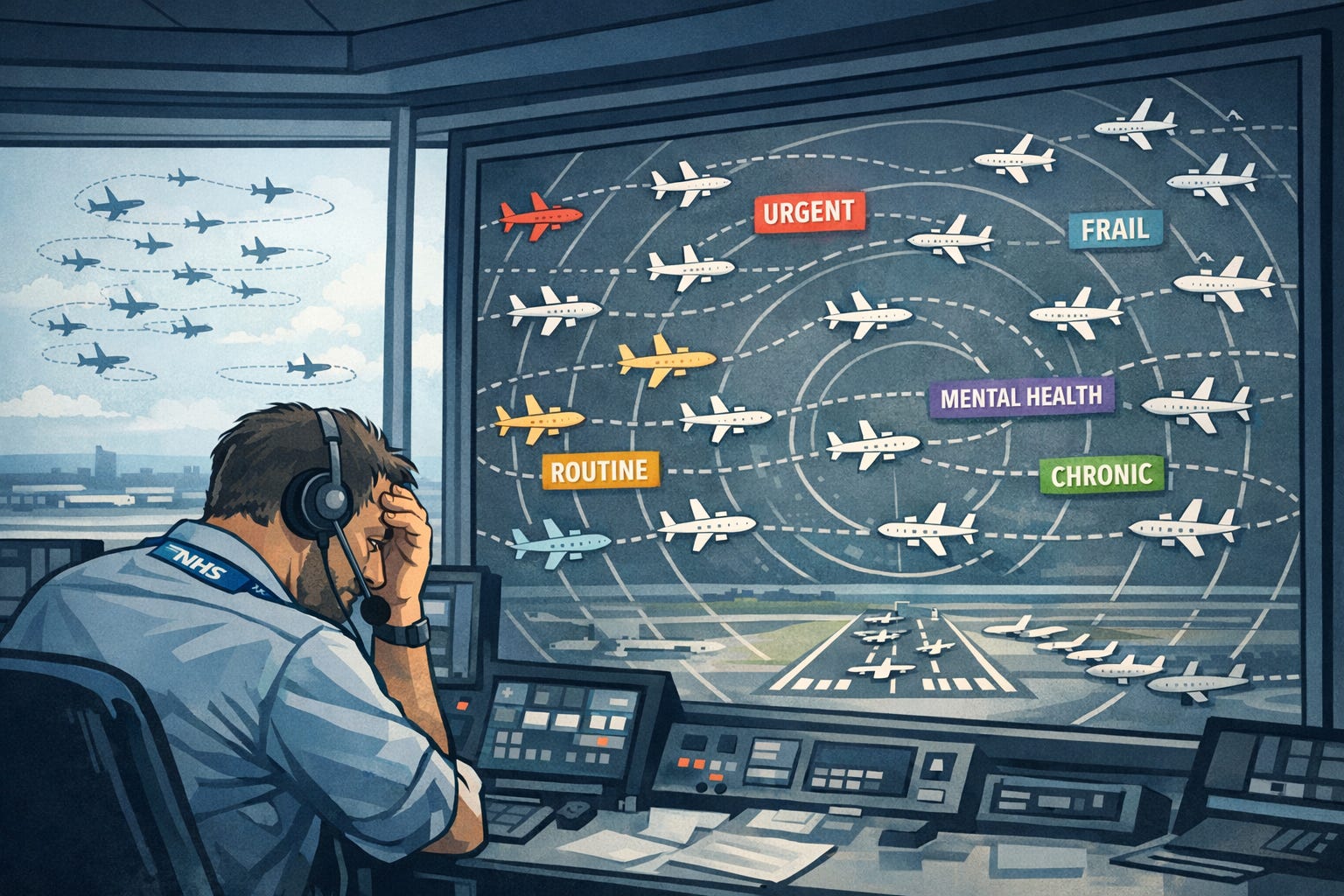
Yesterday (24 February 2026) DHSC published the headlines for the 2026-27 GP contract. Patients will be told they’re getting “better access”, and the political comms will sell it as fixing the “front door” of the NHS.
On the ground, it reads less like “family doctor” and more like air traffic control.
My GP Partner friend Dustyn Saint nailed the metaphor: Pushing Tin. It’s the slang for working a radar scope – keeping aircraft separated, sequencing arrivals, preventing collisions – in a system where you do not control the weather, the runway capacity, or the number of planes entering your airspace.
Now imagine being told: “More planes are coming. Your safety margins stay the same. Your staffing might increase a bit. Do not crash anything.”
That’s the vibe.
What the contract actually says
There are lots of bits in the document, but two clauses carry the emotional payload.
1) Same-day handling becomes a core requirement
NHS England’s contract letter makes it explicit: anything the practice identifies as “clinically urgent” must be “dealt with” the same day. It’s the practice that determines what counts as clinically urgent. For non-urgent needs, there must be an “appropriate response” by the end of the next core-hours period (not necessarily an appointment, but a plan and next steps).
So yes – same-day urgent access is being elevated from “what good practices already fight to deliver” to “contractual requirement with performance oversight”.
2) No capping of online demand
Here’s the part that makes experienced GPs do that slow thousand-yard stare: the core contract is amended to state that online consultation systems must not cap the number of requests submitted during core hours.
DHSC also restates the expectation that online systems stay open through core hours (8am to 6:30pm, Monday to Friday).
That combination is the “all-you-can-eat buffet” problem. It’s not just “be available”. It’s “be available, continuously, at scale, with a mandate behind it”.
And then the other standout: referral gets “permissioned”
The contract embeds Advice and Guidance into core funding and requires practices to use it prior to, or in place of, a planned care referral where clinically appropriate, following local pathways and single point of access models as they arrive.
This is not an outright ban on referral. It’s subtler, and arguably worse in day-to-day workload terms: it moves the friction of a strained secondary care system upstream into general practice workflows.
In air traffic terms: before you can hand a plane to the next sector, you now have to request clearance, wait for a response, and document you followed the local flight plan – while still carrying the clinical risk until that response lands.
The money: “a real-terms increase” that buys… two extra sessions
The government line is a £485m uplift, described as 3.6% cash and 1.4% real-terms growth.
They also point to ~£292m being repurposed into a practice-level GP reimbursement scheme, plus changes to ARRS so experienced GPs can be recruited (not just newly-qualified), with the ringfenced/reallocated funding framed as roughly 1,600 FTE GPs across England.
Let’s translate that into “felt reality”.
England has about 6,229 practices (as of mid-2025), after losing over a thousand in under a decade.
Spread 1,600 FTE GPs across ~6,200 practices and you land at roughly 0.26 FTE per practice – the equivalent of about two extra clinical sessions per practice per week.
That is not a new runway. That is a slightly sturdier high-vis vest for the person waving the planes in.
Why this turns GPs into a triage desk
General practice is already high-volume, high-uncertainty work. The contract itself acknowledges GP teams deliver over 1.4 million appointments every working day.
Now layer in three incentives that all point in the same direction:
1. Throughput is prioritised
Same-day urgent handling becomes contractual, with metrics and ICB “support” triggers if variation is flagged. That pushes practices to optimise for flow: sort quickly, move on.
2. Demand becomes structurally uncapped online
If you cannot cap requests and must keep the system open during core hours, you will inevitably move to faster triage, more templated responses, and more signposting. Not because clinicians are lazy, but because physics is undefeated.
3. Referral becomes an administrative negotiation
Advice and Guidance can be clinically sensible in individual cases. But embedded as a default step, it creates a new class of work: the “pre-referral conversation” that still sits with the GP until it doesn’t.
So the job drifts. Less “doctoring”, more routing.
If you’re a patient, you may still get good care. You may even get faster answers in some scenarios. But you will increasingly experience the system as: form → triage → redirected pathway → another wait → another form. That’s not continuity. That’s airspace management.
The patient experience: the promise vs the lived reality
The political pitch is simple: “same-day for urgent problems”.
But “dealt with” is not the same as “seen by a GP in an appointment”. The contract wording leaves room for response models that satisfy the metric but feel like a downgrade: call-backs, pharmacy diversion, self-care messaging, “booked into the urgent team”, “we’ll message you a plan”.
Meanwhile, a survey released today reported 48% of adults avoid or delay contacting their GP when ill, largely due to appointment access issues.
So we’re about to raise expectations on one axis (same-day urgent) while the system nudges patients into a more transactional interface on another (forms, triage, routing). That mismatch is where anger lives.
The clinician experience: moral injury in spreadsheet form
Air traffic controllers don’t “fail” because they stop caring. They fail when traffic exceeds safe capacity and the system pretends it doesn’t.
General practice is already running with a patient-to-GP ratio that is miles off anything that feels safe. Nationally it’s about 1 fully-qualified FTE GP to ~2,220 patients, while the BMA’s stated ambition for manageable workload and safety is 1:1,000.
Add in the practice closures trend (7,254 down to 6,229 open active practices between 2018 and 2025), and you can see why the mood is so bleak.
The contract doesn’t fix that foundation. It optimises the dashboard.
And dashboards don’t hold your hand when you’re the one deciding, in ten minutes, whether chest pain is urgent, whether a suicidal teenager is “clinically urgent” today, whether the frail patient can wait until tomorrow, and whether the “Advice and Guidance” response will arrive in time to matter.
If we actually wanted to rebuild together
Same-day urgent access is not a stupid goal. It’s just meaningless without capacity, estates, and honest demand management.
If the government wants the “front door” to work, there are a few principles that stop this becoming Pushing Tin:
• Define what is being guaranteed. “Same-day” needs a clinical definition plus a service definition (who, how, and what counts as “dealt with”). Otherwise it’s a promise designed to be broken.
• Cap demand somewhere, transparently. If you refuse to cap, you’re not being patient-centred, you’re outsourcing rationing to frantic triage and burnout.
• Fund capacity over multiple years, not one-year optics. A 1.4% real-terms uplift is not a transformation plan.
• If you embed Advice and Guidance, enforce secondary care response standards. Otherwise it’s just referral friction dressed up as “right place, right time”.
Digital triage that actually learns from local secondary-care response times, shared decision-aid templates that reduce unnecessary A&G loops, or lightweight continuity dashboards that protect the frail elderly from being lost in the throughput machine – none of these are in the contract. They should be the next conversation, not an afterthought.
And yes: you can’t keep shifting work “out of hospital and into the community” if you keep starving the community part of the ecosystem. The planes do not disappear because the tower is busy.
The ending: don’t crash the planes
In Pushing Tin, the whole point is that the people doing the work are not idiots. They are skilled professionals trying to keep everyone safe in a system that mistakes throughput for success.
That’s the fear here.
We’ll meet the mandate by changing the shape of the service. We’ll triage harder. We’ll route more. We’ll shorten conversations. We’ll do more “appropriate responses” and fewer relationships. And the people who lose out will be the ones least able to shout: the frail, the complex, the quietly unwell, the chronic disease patient whose crisis is slow-motion.
This contract doesn’t feel like rebuilding. It feels like being told to handle more traffic with the same runway, and then getting blamed when turbulence happens.
Welcome to the tower. Now push the tin.
Great analogy, @Dave Triska. The new contract is incredibly disappointing. I’ve been waiting over a month for one A&G response( still no response ) , and a referral to the service takes 13 months ( now 14 due to the wait). That’s just one example of the additional risk holding we now do. No secondary care accountability.
Our doors already feel wide open as secondary care doors continue to close.