

Losing Small Wars

The battle for the NHS
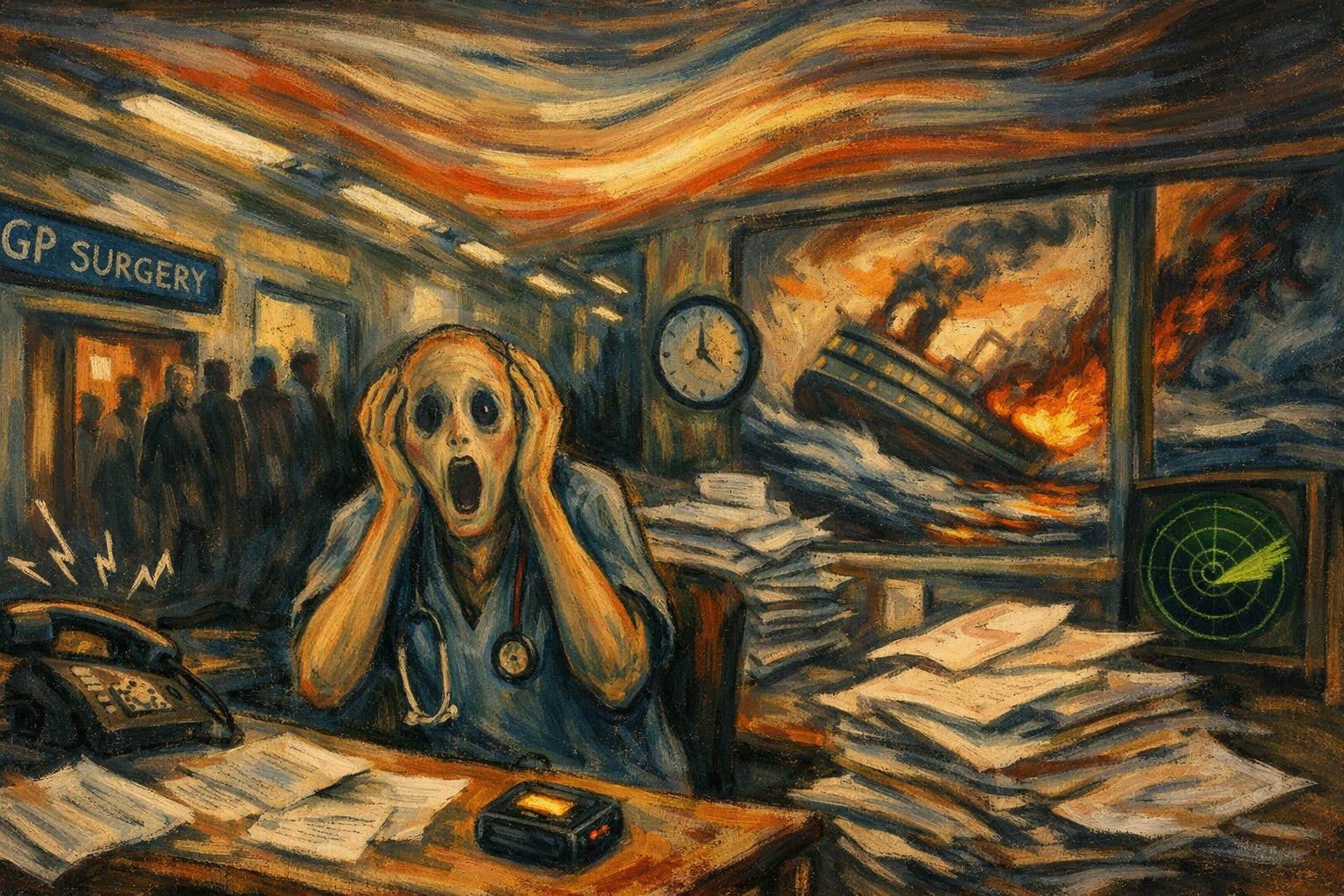
I had a patient this week who didn’t come in with a symptom. They came in with a look that stopped me in my tracks. It happens more and more now.
You know the one. The slightly tight mouth. The polite, practised apology before they’ve even sat down. The sense they’re about to ask for something they have already decided they probably won’t get.
They’d been bounced around the system for months. A referral that went nowhere. A clinic letter that didn’t arrive. A hospital appointment that moved, then moved again. A phone call that turned into a recorded message and then silence. In the end they’d done what people are increasingly doing: they lowered their expectations until they fit the service.
Halfway through, they said, quietly, “Is it me? Am I doing something wrong?”
That is the moment that makes my skin prickle. Because it’s not just one patient asking one question. It’s the NHS teaching people, by repetition and friction, that needing help is a personal failure.
So I did the thing we’re often trained not to do. I told the truth. Not theatrically. Not angrily. Just plainly.
I said the system is overloaded. I said waits are long across primary and secondary care. I said referrals and onward care are under pressure and sometimes fall into cracks that are not the patient’s fault. I said general practice is being asked to carry more risk with fewer people. I said I’m worried about what comes next.
And the patient didn’t panic.
They exhaled. Their shoulders dropped about half an inch. The look on their face wasn’t fear. It was relief.
“Thank you,” they said. “I thought it was just me. I thought I was going mad. Is this how it is now?”
That’s when I realised how deep this particular rot goes. The public already knows something is wrong. They can feel it in their bones every time they try to get care. The only people still pretending everything is basically fine are often the ones who write the plans, and sometimes the ones of us who are too frightened to say out loud what we all say in private.
This piece started with the GP contract because it has that familiar upstream tone of confidence, that sense that if you rearrange the wording and the incentives you can conjure capacity out of thin air. But the contract is just the spark. The firewood has been stacked for years.
The uncomfortable part is this: I think we are becoming experts at losing small wars in the battle for the soul of the NHS.
Why that phrase? For good reason - Losing Small Wars is a book about Afghanistan, specifically about how a modern army can be incredibly brave, incredibly busy, and still fail. It’s not a book about cowardice. It’s a book about a culture that confuses relentless effort with progress, and treats honesty as disloyalty.
One of the images it returns to is the patrol base or forward operating base. A small group of people, isolated, surrounded, taking contact, short of manpower, doing the work anyway. They keep going because that’s what professionals do. They send their sitreps back up the chain: calm, controlled, reassuring. They report activity. They report outputs. They report that the plan is on track.
And the longer it goes on, the harder it becomes to say the sentence that matters: this is not working.
Not because it isn’t true, but because saying it makes you the problem. You become the awkward voice. The morale-sapper. The one who “doesn’t get it”. The one who is told to crack on.
If you’re a GP partner reading this, you already know why I’m using that book title.
A GP surgery is a patrol base now. Not in the melodramatic sense. In the organisational sense.
Small team. Fixed walls. Constant incoming. The radio never stops. The jobs stack up. The risks drift towards you because gravity always pulls downhill. You hold the line for a population while the rest of the system is jammed. You create order out of chaos, not because you’re resourced, but because your professional identity won’t allow you to let go.
And then you write the local version of a sitrep. Sometimes literally, sometimes metaphorically. You describe access. You describe demand. You describe activity. You describe “pressures”. You reassure, because reassurance is what gets you left alone. You soften it, because you’re tired and you don’t want to fight another battle, this time with your own hierarchy.
The phrase “busy but coping” has done more damage to the NHS than any politician.
Because “busy but coping” is the sentence that launders risk.
It translates “unsafe” into “resilient”.
It translates “we are haemorrhaging staff” into “workforce challenges”.
It translates “people will come to harm” into “winter pressures”, as if harm is seasonal like a cold.
We have developed an entire dialect designed to make emergency sound normal.
And that is where the moral injury lives. Not in the workload alone, although the workload is brutal. Not in the public anger alone, although the public anger burns. It lives in the gap between what we know is happening and what we feel permitted to say, upwards and outwards.
We tell ourselves we are protecting patients by not worrying them. But in practice we are protecting an illusion, and the public pays for that illusion with time, pain, and delay.
Here’s the part that should make you uncomfortable, because it makes me uncomfortable: patients are not fragile. They are not stupid. They can cope with truth far better than they can cope with being quietly blamed for the system’s failure.
When we stay vague, patients invent explanations. They assume they’re missing a trick. They assume they’re the only one. They assume they’re being fobbed off. They assume we don’t care. They turn their anger sideways into themselves, or directly into us. Either way, the relationship fractures.
When we are honest, done properly, it does something different. It gives people a coherent story. It gives them a place to put their frustration that isn’t self-loathing. It gives them a sense that their GP is in the same reality they are.
Honesty does not automatically “undermine confidence”. Sometimes it restores it. Because confidence is not built by pretending the building isn’t on fire. Confidence is built by admitting the smoke and telling people where the exits are.
So why won’t we do it?
Because the NHS has its own chain of command, and its own version of contact. The contact isn’t bullets. It’s complaints. It’s regulatory fear. It’s being singled out. It’s reputational risk. It’s the anxiety that if you say what you think you will be labelled unprofessional, political, negative, difficult.
You can almost feel it in your body, can’t you. The little clamp in the chest. The calculation. The instinct to keep your head down and keep the base running.
That instinct is understandable. It is also killing us.
Because there is a point where “crack on” stops being resilience and starts being complicity.
The Afghanistan lesson in Losing Small Wars isn’t that people should have worked harder. They were already working hard. The lesson is that when reality is bad and the plan is unworkable, the bravest thing you can do is report accurately even when it makes you unpopular.
In general practice, accurate reporting does not mean a dramatic social media rant. It does not mean scaring patients for sport. It does not mean broadcasting despair like it’s a personality trait.
It means refusing to participate in the polite fiction.
It means saying in the meeting, with your name on it, that the numbers do not add up.
It means writing the risk down rather than absorbing it.
It means stopping the translation of “we cannot do this safely” into “we are under pressure but managing”.
It means supporting the colleague who says it out loud instead of leaving them to hang in the air like a bad smell.
Because this is the trap of small wars, whether in Helmand or healthcare. People at the edge keep the thing running through sheer effort, so leaders can keep believing the plan is working. The outpost holds, just about, so the strategy never changes. The cost is paid in exhaustion, moral injury, and eventually in harm.
And harm is the bit we keep skirting around because it feels too stark to say.
Let’s say it.
If access expectations rise while workforce and downstream capacity do not, people will come to harm. Not as an abstract possibility. As an inevitability. Delayed diagnoses, missed deterioration, untreated mental illness, decompensated chronic disease, avoidable admissions, avoidable deaths. It is not hysteria to name that. It is the most basic form of clinical realism.
The uncomfortable question is what we do with that realism.
Because patients do not need us to go down fighting heroically, collapsing quietly at our desks with a martyr’s glow. That is not noble. It is just convenient for everyone above us.
Patients need us to stand up.
Stand up in the only way that matters in a bureaucracy. By telling the truth into the radio.
Not once, not privately, not in the closed groups where we all nod and then carry on. Out loud, consistently, together, with enough unity that it stops being one awkward GP and starts being a profession refusing to gaslight the country.
If you’re reading this and feeling that twist in your stomach, that is the point. That twist is your conscience saying it recognises the pattern.
Losing small wars is what happens when brave people keep surviving the day and never change the plan.
This is the moment, right now, where general practice has to decide whether bravery means keeping the patrol base running at all costs, or whether it means sending the sitrep that finally forces someone to confront reality.
Enough is enough is not a slogan. It is a clinical judgement.
And if we can see the harm coming, we do not get to call ourselves professionals while we politely look away.
Some of the terms may not be familiar to all:
Patrol base (PB) / Forward operating base (FOB)
Small military outposts used to project presence and operate from. In Helmand they could be isolated, under constant pressure, short on resources, and still expected to keep functioning and reporting “all good”.
SITREP (situation report)
A structured update sent up the chain of command describing what’s happening on the ground. In a strained system, SITREPs can become “optimism-filtered” so senior leaders hear what’s palatable, not what’s true.
Chain of command
The hierarchy that information and decisions move through. It can create an “optimism gradient” - the higher information travels, the more it gets softened to avoid friction, blame, or career risk.
Contact drill / “taking contact”
Military shorthand for coming under enemy fire and reacting. I’m using it as a metaphor for constant demand pressure - workload, risk, interruptions, and crises arriving faster than they can be safely absorbed.
Helmand
A province in southern Afghanistan where British forces operated heavily (notably in the mid-2000s). It became emblematic of grinding effort at local level without strategic progress.
“Crack on” culture / heads-down mentality
A professional reflex: keep going, don’t complain, don’t escalate, just cope. Useful in short bursts, dangerous when it becomes the default operating model - because it hides failure and normalises harm.
Moral injury
The psychological and emotional damage from being forced to act against your values, or from repeatedly witnessing avoidable harm while feeling powerless to stop it.
Laundering risk upwards
When front-line teams quietly absorb unsafe workload, delays, and hazards, then describe the situation in euphemisms (“pressures”, “challenges”) so leaders perceive the plan as workable. The risk doesn’t disappear - it just becomes invisible until it bites.
Optimism gradient
The tendency for bad news to get diluted as it travels upward. The people closest to reality feel it most; the people furthest from it often receive the most reassuring version.
Normalising harm
The slow process where repeated service failure becomes treated as standard, inevitable, or acceptable. Once harm is normalised, urgent warning signs start to sound “overdramatic”.
GP contract
The set of funding and operational requirements imposed on practices. My point isn’t a technical critique of one clause - it’s that repeated “do more with less” expectations create a permanent mismatch between demand and capacity.
"Busy but coping" is the sentence that launders risk.
That line will stay with me for a long time. Because it names something I've watched happen across every part of the public sector, not just general practice, the systematic conversion of unsafe into resilient through language.
What you're describing isn't a communication problem. It's a design problem. The reporting systems, the governance structures, the board papers, they're almost perfectly engineered to translate reality into reassurance before it reaches anyone with the authority to act on it. By the time the sitrep gets to the top, it doesn't sound like a sitrep anymore. It sounds like a plan.
The Afghanistan parallel is uncomfortably precise. In Helmand, patrol bases held ground that the strategy said was already secured. In general practice, surgeries absorb risk that the contract says is already managed. In both cases, the people at the edge pay the cost of the gap between the plan and reality, and the plan never updates because the reporting says it's working.
The patient who asked "Is it me?" that's the version of this that should be read into every board meeting in the NHS. Because that question is the end product of a system that has learned to make its own failure invisible by distributing the blame downward until it lands on the person with the least power to do anything about it.
Your point about honesty restoring confidence rather than undermining it is the one most leaders get backwards. The public isn't fragile. They're gaslit. There's a difference. And the relief your patient felt when you told the truth is the same relief every frontline team feels when someone finally says in the meeting what everyone says in the car park afterwards.