

Ghosts

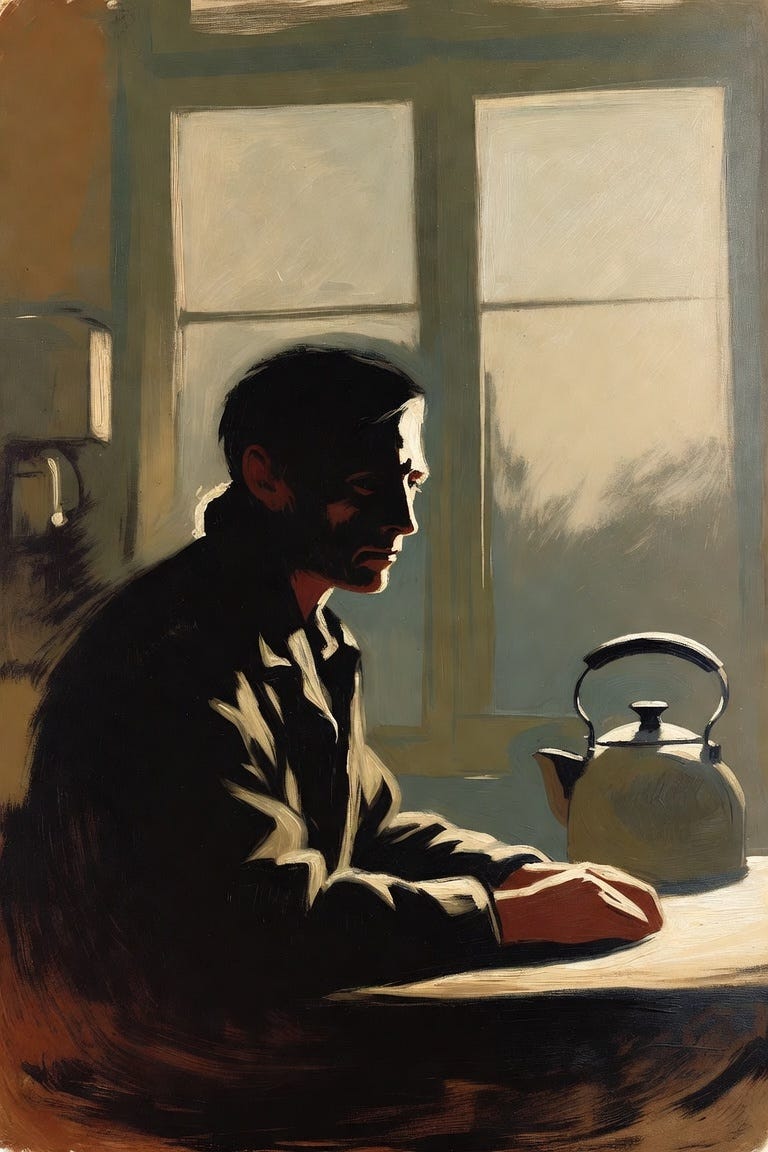
The heat is the first thing. Close and wet and refusing to lift, the kind that sits on you like a second skin you cannot shed, that you have stopped sweating through because there is nowhere left for the sweat to go. It runs into your eyes and you let it. There is grit between your teeth, grit in the corners of your eyes, a paste of dust and sweat in every crease of you. The air tastes of diesel and hot dust and something faintly burning you long ago stopped asking about. There is a foil pouch in your hand - jalapeño cheese, claggy and oversalted, coating the roof of your mouth - and you are eating it not because you want it but because the body needs fuel and this is what there is.
Then, out in the dark, something comes down hard.
And before you have thought anything at all, before the sound has even finished, your gut has dropped and your chest has locked and you are flat and small and listening with the whole of your body, every hair up, waiting to learn whether it was meant for you.
None of this is happening.
I am in Surrey. The kettle is in the next room. The dog is asleep under the desk and nothing is coming down out of the dark, because the dark, here, is just the dark. But my mouth has gone to chalk and my heart is going, and it will be a minute yet before the rest of me believes the room.
The weather turned this week - thick, sticky, grimy heat that would not break - and a door opened that I keep meaning to brick up, and I had walked through it before I’d decided to. Sixteen years and a few thousand miles, gone, in the time it takes to notice you are sweating.
I know what to call this now. A woman taught me, earlier this week, sitting in the chair across from my desk.
What she came in to say
She came in on the Tuesday, the ninth name on a list that had started before I’d finished my coffee, and she had come about her blood pressure. The cuff went on. The numbers were fine. We were nearly done, the ten minutes nearly spent, my hand already drifting back toward the keyboard, when she said - almost as an afterthought, the way people deliver the thing they actually came in to say - that she had cried in a restaurant the week before.
A song came on. One she used to dance to. For someone long since gone.
“Silly, really,” she said, and waved her hand at it the way you’d wave away a fly. She was apologising. Not for crying. For having been ambushed in public, over a risotto, by three bars of music she had not chosen to hear.
I watched her leave for a second. Just a second. Her eyes went somewhere that was not this room, not this Tuesday, not the cuff coiled on the desk between us. Somewhere with a dance floor in it. Then she came back, reached for her coat, said sorry again.
Most people would have missed it. The man across the restaurant table missed it - carried on with the wine, asked if she was alright, moved on when she said she was fine. Her own family might miss it, because they have learned that she is “fine,” and fine is easier to believe than the alternative.
I didn’t miss it. I’d had my own, three days running, every time the air went thick.
That is the only reason I knew what I was looking at. The door opening. The walking through.
Same wiring
Here is what I find almost unbearable, and almost beautiful.
Her ghost is love. A song, a dance, a hand at the small of her back, a person who is gone and who comes back for the length of a chorus whether she can bear it or not. Mine is fear. The crash in the dark, the body bracing, a readiness that never fully stands down even now, even here, even with the kettle in the next room.
Opposite ends of everything a person can feel. And the machinery is identical.
The same circuit that hands her one more dance hands me one more night I would rather not revisit. The same flood of chemistry. The same hijack. The body does not sort the file before it opens it. It does not check whether what it is about to hand you is a man you loved or a road that nearly killed you. It dumps the lot - the heart kicking, the eyes wet, the gut gone to water, the skin risen to gooseflesh - and lets the slow conscious mind catch up a half-second behind, holding something it never asked to be handed.
The body keeps time. It just does not take requests.
It does not ask whether you are ready. It does not ask whether you are in a restaurant or a surgery or halfway round the supermarket. It does not ask whether the memory is one you’d queue for or one you would pay good money never to see again. It does not ask permission at all. It opens the door - a smell, a song, a slant of light, the wrong grade of heat on your skin - and the past walks in and sits down in the chair that was empty a moment ago.
And you have a ghost too.
You might not call it that. You might call it “getting a bit emotional.” You might call it “I don’t know what came over me.” You might have a song you skip before the second line, a road you do not drive down, a perfume that stops you dead in the middle of a shop with your pulse climbing for no reason anyone around you could see.
You didn’t install any of it. That is the part nobody mentions. Nobody handed you a manual, nobody asked which doors you wanted fitted, and nobody left you the key.
What I didn’t say
If I could, I would turn mine off. I think most veterans would, if you caught them honest and tired enough to admit it.
But there is a cost to that wish, and I only understood it properly while watching her wave her hand and call herself silly.
If I could turn mine off, she would lose hers too. You do not get to keep the song and refuse the crash. It is one mechanism, not two. The door that lets the dust back in is the same door that lets him back for a chorus. There is no settings menu where you keep the people you have lost and decline the things you have survived.
So she cries in a restaurant. And I lose an afternoon to Helmand because the weather turned. And a man somewhere flinches at a ringtone that has not meant anything in fifteen years. And a woman cannot walk down a particular corridor because of what the floor smells like.
We are all of us walking around as the present-day custodians of a past that occasionally lets itself in. Some of us are haunted by terror. Some by tenderness. Most of us, if we are honest, by both - and we cannot always tell you which is which until it is already in the room, sitting in the chair, wearing a face we knew.
I wanted to tell her that the crying was not a malfunction. That it was, if anything, proof the wiring still works - that she had loved him enough to be ambushed by him over a risotto, all these years on. That the tears were the dance, still going, in the only place it can still happen.
I didn’t say any of that. There were eight names left on the list and the door was already half open behind her.
I just told her, again, that it wasn’t silly. And I watched her go back out into a Tuesday that had no idea where she had just been.
So do I.
Luscious storytelling. Thanks from a fellow doctor/writer (who has also just written a substack called Ghosts, weirdly).